AI SEO tools have stopped being a novelty. For a Magento store with 5,000 or 50,000 SKUs, manually optimising every page is simply impossible, and the stores that treat technical SEO as a one-time audit are being overtaken by those that treat it as a continuous, partially automated process. At Qarbi we run an AI-powered SEO workflow on our own site and on client Magento stores, and this guide is a direct write-up of what is actually in our stack, how much it costs in AUD, and where it has failed us.
This is a companion to our Claude Code guide. Where that piece focuses on using Claude Code for Magento development, this one focuses on the SEO side: technical audits, meta tag generation at catalogue scale, JSON-LD schema automation, content briefs, and internal linking analysis. Everything below has been run in production on a real Magento 2 store.
Pair this with the product-copy playbook: AI Product Descriptions for Magento: How to Generate SEO-Optimised Copy for 5,000+ SKUs covers the prompt framework, AUD model costs, and Magento REST API import pipeline used to re-describe a 2,400 SKU catalogue in under 3 days.
Key takeaway: The honest version: AI SEO tools will not give you rankings. What they will give you is the ability to cover ground - every product page, every category, every meta tag, every schema block - that you previously had to ignore because you did not have 40 hours a week to spend on SEO operations.
Why Magento Stores Need AI-Powered SEO
Magento is a catalogue-heavy platform. A typical mid-market Magento store has between 3,000 and 20,000 active SKUs, each of which needs a unique meta title, meta description, product schema, open graph tags, image alt text, and ideally a genuinely useful long-form description. Multiply any of those by 10,000 and you have a problem that no SEO agency can solve economically at Australian labour rates.
The numbers make the case clearly. At an average AU agency rate of AUD 185 per hour, writing a unique meta title and description for 5,000 products at 3 minutes each works out to approximately AUD 46,250. Hand-coding JSON-LD Product schema for the same catalogue, including variant handling and breadcrumbs, is another 40 to 60 hours. A proper technical audit covering robots.txt, sitemap health, canonical tags, hreflang for any AU/NZ split, and crawl budget optimisation is another 25 to 40 hours. You are staring at AUD 60,000+ before you have written a single blog post.
AI changes the unit economics. The same meta tag generation job runs on Claude Sonnet in roughly 25 minutes of wall-clock time and AUD 12 to 25 of API credits. The schema job is an overnight script. The technical audit is under 4 hours with Claude Code and a few MCP servers. The point is not that AI replaces an SEO specialist - it does not - but that it removes the economic ceiling on how much SEO work a store can actually ship.
| Task | Manual (AU agency) | AI-assisted (our stack) | Time saving |
|---|---|---|---|
| Technical SEO audit (10k URLs) | 40-60 hours @ AUD 185/hr | 3-4 hours + AUD 8 API | ~92% |
| Meta titles + descriptions (5k products) | 250 hours @ AUD 185/hr | 25 min + AUD 18 API | ~99% |
| Product JSON-LD schema rollout | 40-60 hours dev time | Overnight script + AUD 6 API | ~95% |
| Content brief (single long-form post) | 3-4 hours research | 20 min + AUD 0.30 API | ~90% |
| Internal link audit (topical clusters) | 12-20 hours | 30 min + AUD 1 API | ~95% |
The savings are real but they come with a condition: the AI needs scaffolding. You cannot point a raw LLM at a Magento database and get useful output. The stack described below is what actually makes the numbers above hold up in practice.
Our AI SEO Stack: Claude Code + MCP Servers + DataForSEO
There are three pieces to our SEO stack and none of them is a branded 'AI SEO platform' like Surfer or Frase. We tried those and they are genuinely useful for generalist content marketing, but they do not integrate with Magento's database, they do not know your product catalogue, and they cannot execute the changes they recommend. The stack below addresses all three gaps.
- Claude Code - Anthropic's CLI agent. This is the orchestration layer. It reads files, executes shell commands, hits APIs, and reasons about what it finds. For SEO work it acts as the 'senior SEO engineer' in the loop.
- MCP servers - Model Context Protocol servers that connect Claude Code to external systems. We run a Postgres MCP server (for the Magento database), a Playwright MCP server (for live crawling), and a filesystem MCP server (for template files). This is what lets the AI actually see and touch a real Magento store.
- DataForSEO API - Programmatic SERP data, keyword volumes, domain metrics, and backlink data. At approximately AUD 0.003 per SERP query, it is the cheapest way to feed real ranking data to an LLM that needs to reason about competitive positioning.
The three pieces are cheap individually. Claude Code is a few dollars a day at our usage. DataForSEO credits are under AUD 30 a month for a working agency. MCP servers are free and open source. Total stack cost for the Magento workflow below is under AUD 100 a month, which is less than a single seat of most commercial AI SEO platforms.
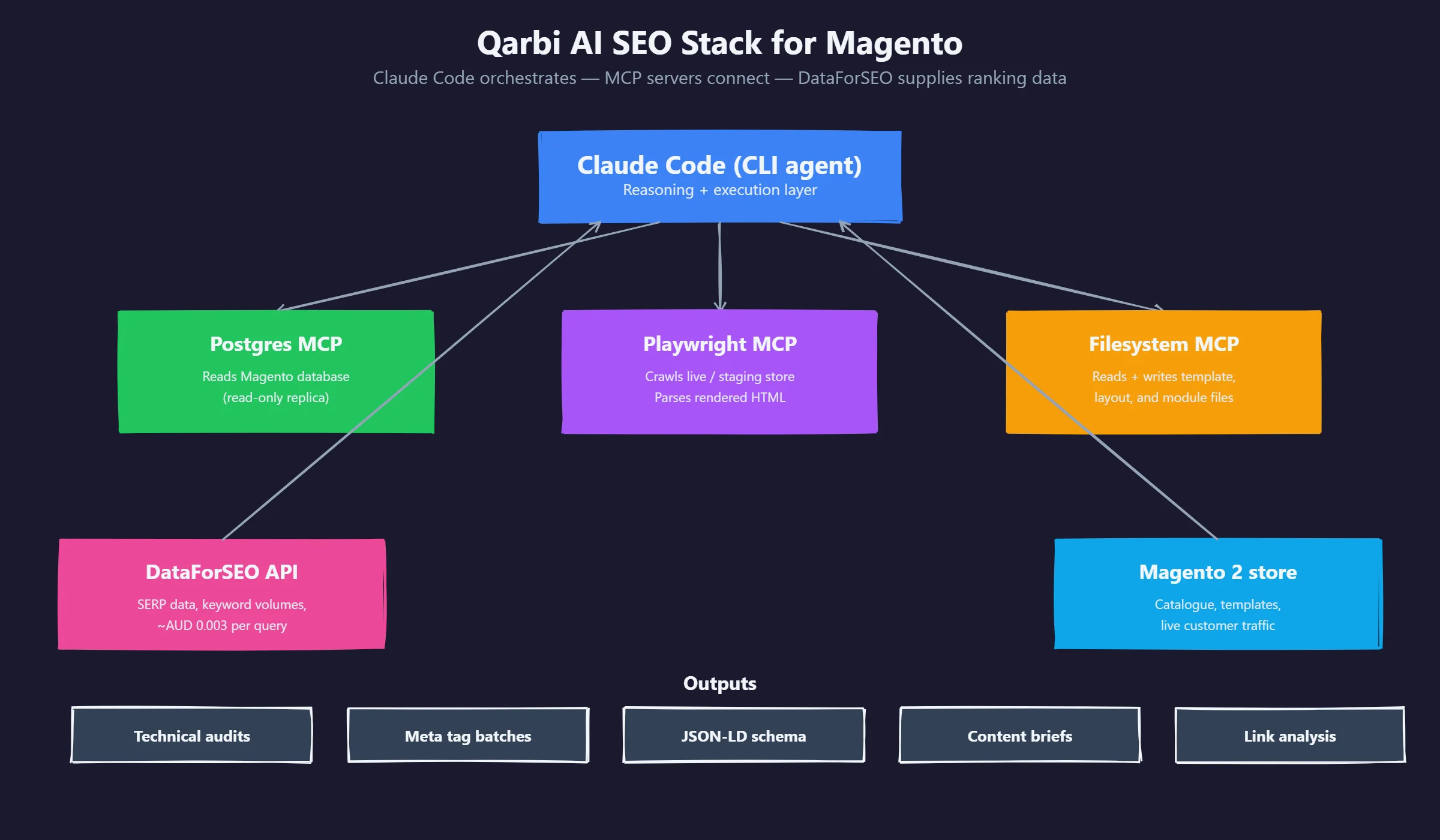
Commercial AI SEO platforms are optimised for blog-style content teams. They do not read your Magento database, they cannot write to your product table, and they charge per seat at AUD 70 to AUD 300 a month. For a store with 5,000 SKUs, the bottleneck is not content ideas - it is execution at catalogue scale. Claude Code plus MCP plus the Magento REST API can actually execute. That is the difference.
Automated Technical SEO Audits
The first thing we do with any new Magento store is run a full technical audit. Before Claude Code, this was a 2-day ordeal involving Screaming Frog, Sitebulb, manual robots.txt review, and a spreadsheet of canonical tag issues. Now it is an afternoon, and the output is not a PDF - it is a pull request with the actual fixes.
The audit pipeline we run looks like this:
- Crawl - Claude Code orchestrates a Playwright crawl of the full Magento store, respecting robots.txt and rate limits. For a 10,000-URL store this takes 30-45 minutes.
- Parse - For every page, extract title tag, meta description, canonical URL, hreflang tags, status code, response time, H1, open graph tags, and schema blocks. Store in a local SQLite file for the agent to query.
- Diagnose - Claude Code queries the crawl data looking for duplicate meta titles, missing descriptions, broken canonicals, orphaned pages, thin content (under 300 words on indexable URLs), and schema errors.
- Fix - For each category of issue, the agent writes or updates the relevant Magento template, module, or database value. For bulk data fixes it generates a SQL migration or a REST API batch job.
- Verify - Re-crawl the affected URLs and confirm the fixes landed. Generate a change report.
The code-level work happens in the Magento codebase, so the agent needs to understand Magento's conventions (di.xml, layout XML, block classes, view models). We store a Magento coding conventions file in the project so Claude Code has the context. A typical initial audit catches 150 to 400 distinct issues on a store that has never had structured SEO work done. The agent proposes fixes for roughly 80 percent of them automatically; the remaining 20 percent need human judgment (should this category page be noindexed? is this 'duplicate' actually intentional?).
          # Example: run a technical audit from the shell
# This is the actual command we use, simplified for the blog
claude "Audit the live Magento store at staging.example.com.au.
  Use the Playwright MCP to crawl up to 2,000 URLs.
  Store results in ./audit.sqlite.
  Report: duplicate meta titles, missing descriptions,
  broken canonicals, and orphaned pages.
  For fixable issues, propose a Magento block or template change.
  Do NOT make changes - output a diff only."
Two things that surprised us in practice. First, the agent is better at detecting schema errors than most commercial tools because it actually parses the JSON-LD and reasons about it, rather than pattern-matching. Second, it is worse than expected at prioritisation - it treats a duplicate meta description on an orphaned category as equally important to one on a top-selling product. We solve this by giving it access to Google Analytics session data so it can weight issues by page value.
AI-Generated Meta Titles and Descriptions at Scale
Meta tag generation is the single highest-value automation in the Magento SEO workflow. Most stores we audit have meta titles that are either Magento's default (product name followed by the store name) or a single hand-written title that was copied across thousands of products and stopped being accurate three years ago. Neither option ranks.
The process we use for bulk meta tag generation:
- Export the product catalogue via Magento REST API to CSV, including name, SKU, category, short description, attributes, and current meta tags.
- Run Claude with a structured prompt that includes the brand voice guide, keyword targets for the category, and hard constraints (under 60 chars for title, under 155 for description, primary keyword in title, includes brand name, Australian English).
- For each row, the model outputs a JSON object with the new title, description, and a one-line justification citing which keyword it optimised for.
- Human reviewer (this is not optional) spot-checks 10-15 percent of the rows. If the acceptance rate is above 90 percent, batch-import via REST. If not, tighten the prompt and re-run.
- Monitor Search Console for CTR changes over the following 6-8 weeks. A well-optimised bulk rewrite typically lifts CTR by 8 to 22 percent on previously-default titles.
| Store size | Products | Claude API cost (AUD) | Human review hours | Total wall-clock |
|---|---|---|---|---|
| Small | 500-1,000 | AUD 2-5 | 2-3 hours | 4-6 hours |
| Mid-market | 3,000-8,000 | AUD 12-25 | 6-10 hours | 1-1.5 days |
| Large catalogue | 15,000-30,000 | AUD 55-110 | 20-30 hours | 3-4 days |
AI will confidently generate a meta description that claims your product is 'made in Australia' when the supplier is Shenzhen. This is not a hypothetical - we have seen it. The ACCC treats false country-of-origin claims seriously under Australian Consumer Law, and a negligent AI rollout is still your legal exposure. Human review of at least 10 percent of outputs is the minimum. For regulated categories (food, health, cosmetics), review 100 percent.
Schema Markup Generation and Validation
JSON-LD structured data is the part of SEO that almost every Magento store under-invests in, and it is the part where AI offers the cleanest ROI. Google's rich results depend on it, AI answer engines depend on it even more, and writing it by hand across a large catalogue is tedious enough that most teams give up after the homepage.
Our automation generates four schema types across the Magento catalogue: Product (with offers, aggregateRating, and brand), BreadcrumbList (from the category tree), FAQPage (for any product that has a structured Q&A section), and HowTo (for products where the store has added assembly or usage instructions). The HowTo coverage is a differentiator - most ecommerce stores do not ship HowTo schema at all, and it wins rich result real estate that competitors are not competing for.
The generation pipeline
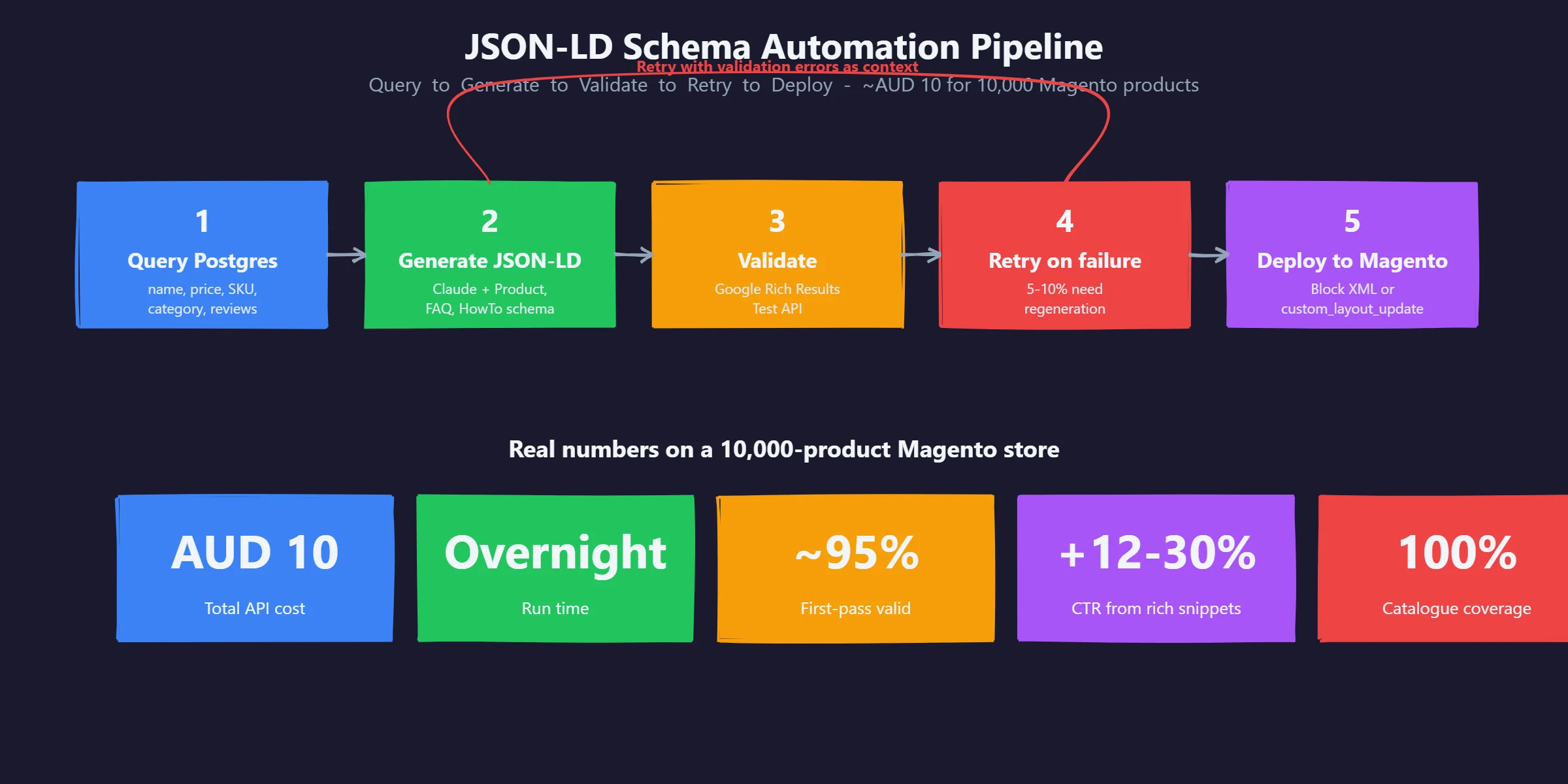
- Query the Magento database via the Postgres MCP server for product data: name, SKU, price, description, category tree, attributes, review summary, image URLs.
- For each product, Claude generates a complete JSON-LD object using a prompt that includes the official Schema.org Product specification as context.
- Validate every output against Google's Rich Results Test using the public API. Invalid outputs get regenerated with the validation errors fed back as additional prompt context.
- Write the validated schema to a new Magento block or directly into product custom_layout_update XML.
- Deploy and re-crawl the affected URLs to confirm Google sees the markup.
At Claude Sonnet pricing, this runs at approximately AUD 0.0008 per product for the generation pass and another AUD 0.0002 per product for the validation retry on the 5 to 10 percent that fail first time. A 10,000-product store pays roughly AUD 10 total for full schema coverage. The result is indexed by Google within a few weeks and, on stores where we have deployed it with baseline tracking, drives a 12 to 30 percent increase in CTR from rich snippet listings.
          {
  "@context": "https://schema.org/",
  "@type": "Product",
  "name": "Merino Crew Neck Jumper - Australian Wool",
  "sku": "MW-JUMP-NVY-M",
  "brand": { "@type": "Brand", "name": "Example Co" },
  "image": [
    "https://example.com.au/media/catalog/product/mw-jump-navy-01.jpg"
  ],
  "description": "100% Australian merino wool crew neck jumper...",
  "offers": {
    "@type": "Offer",
    "priceCurrency": "AUD",
    "price": "189.00",
    "availability": "https://schema.org/InStock"
  },
  "aggregateRating": {
    "@type": "AggregateRating",
    "ratingValue": "4.7",
    "reviewCount": "142"
  }
}
Content Brief Generation and Blog Publishing
Technical SEO gets you to the starting line; content is what actually moves rankings over time. For a Magento store the content layer includes blog posts, buying guides, category copy, and - increasingly - AI-answerable FAQ content. AI is useful at every stage of this pipeline, but the failure mode is generating bland, undifferentiated content that looks like everything else on the SERP. Our workflow is designed specifically to avoid that trap.
The content pipeline we run:
- Keyword research - DataForSEO API pulls search volumes, difficulty, related keywords, and the current top 10 for each candidate topic. Filter by realistic difficulty for the domain authority of the site.
- SERP analysis - Claude fetches the top 3 ranking pages, extracts their H2 outlines, word counts, content format (listicle, guide, comparison, etc.), and identifies topics they cover.
- Gap analysis - What do the top 3 NOT cover that the site could realistically talk about? For an Australian Magento store that is usually AUD pricing, local integrations, or first-hand implementation experience.
- Brief generation - Claude writes a structured brief with target keyword, word count target (30% above SERP average), required H2s, required data points, internal link targets, and a 'unique angle' paragraph.
- Draft - Human writer or Claude generates the first draft from the brief. For technical content, Claude is faster; for brand-voice content, human writers still win.
- Publish - Post goes through our blog API, schema is auto-generated, social cards are rendered, internal links back to the pillar and siblings are validated.
This is the exact pipeline that published the post you are reading. Our content team reviews every draft and usually edits 15 to 25 percent of the copy, mainly for brand voice and to add first-hand details the AI cannot know. The time saving is mostly in the research and brief stages, not the writing itself.
AI Internal Linking Analysis
Internal linking is where most Magento SEO strategies quietly fall apart. Every store knows they should build topical clusters and link related content together, and almost no store actually maintains the link graph as content is added and removed. The result is orphaned pages, broken clusters, and link equity pooling on the homepage instead of flowing to money pages.
AI makes this tractable in a way it was not before:
- Crawl the full site and build a graph of page-to-page internal links.
- For every pair of pages, calculate a topical similarity score using embeddings. Two pages that cover the same topic but do not link to each other are a missed opportunity.
- Identify pillar candidates - pages with high inbound links and broad topical coverage - and supporting pages that should link up to them.
- Flag orphaned pages (zero internal links in) and overlinked pages (more than 50 internal links out, usually the homepage or a mega menu bug).
- Generate a prioritised action list: which pages need new internal links, what anchor text to use, and what context paragraph to add.
On a mid-market Magento store this analysis takes about 30 minutes of agent time and AUD 1-2 of API cost. The action list typically surfaces 200 to 800 link additions. The pattern that comes up most often is product pages not linking back to their parent category article, and blog content not linking across to the related product collection. Fixing those two patterns alone moves the needle on almost every audit we run.
Comparing AI SEO Tools: Head-to-Head for Ecommerce
The reality is that no single tool covers the whole workflow. Most AI SEO platforms are optimised for generalist content marketing, not Magento catalogue work. Here is how the main options actually compare for an Australian ecommerce team in 2026.
| Tool | Primary strength | Magento fit | AUD pricing (2026) | Catalogue scale? |
|---|---|---|---|---|
| Claude Code + MCP + DataForSEO | Execution, database access, schema generation | Excellent - can touch the Magento codebase | ~AUD 80-120/mo all-in | Yes |
| Surfer SEO | Content brief generation, on-page content scoring | Poor - no Magento integration | AUD 130-410/mo | No - blog-focused |
| Frase | SERP analysis, content brief generation | Poor - no catalogue awareness | AUD 75-175/mo | No |
| Clearscope | Content scoring against top-ranking pages | Poor - no Magento integration | AUD 275/mo+ | No |
| Semrush + AI Writing Assistant | Keyword research plus content scoring | Fair - has a Magento site audit but not SEO automation | AUD 185-720/mo | Partial |
| Screaming Frog + custom scripts | Technical crawl with AI-assisted diagnostics | Good for audits, not for writes | AUD 380/yr licence | Partial |
We use commercial tools alongside the Claude Code stack for specific jobs. Screaming Frog is still the fastest way to do a one-off crawl on a large site, and we feed its output into Claude for diagnosis. Semrush is useful for competitor intelligence and backlink analysis, where DataForSEO's data is thinner. The branded 'AI SEO platforms' (Surfer, Frase, Clearscope) we no longer use internally - they are fine tools, but their optimisation target is content teams writing marketing blog posts, not SEO engineers maintaining a 15,000-SKU Magento catalogue.
What AI SEO Cannot Do (Yet)
It would be dishonest to write this guide without being clear about the limits. Over 18 months of running AI-assisted SEO for our own site and for clients, we have seen consistent failure modes that are not going to be solved by the next model upgrade.
- Link building - AI can draft outreach emails, but it cannot earn a link. The best it can do is shortlist prospects and personalise the first sentence. The relationship work is still human.
- Genuine E-E-A-T - Google's Helpful Content system weighs first-hand experience heavily. 'I tested this product in my own 5,000-SKU Magento store' is a sentence AI cannot truthfully write on your behalf. This is why most AI-generated content looks and ranks like AI-generated content.
- Editorial judgment - AI will generate 10 content briefs that all look reasonable. Knowing which one to actually publish, based on the business's current priorities and the team's bandwidth, is still a human call.
- Creative content angles - AI is very good at the average of what is on the SERP and very bad at the angle nobody else has thought of. The post you are reading started as a human idea; AI assisted with the writing, not the framing.
- Trusted facts about your business - AI will hallucinate your founding year, your headcount, your founder's background, and your product's origin. Every factual claim about the company needs to come from a human.
The takeaway is not that AI SEO is overrated. It is that the division of labour has changed. The machine does the 80 percent of the work that was previously unglamorous and slow. The human does the 20 percent that actually makes content rank - angles, facts, judgment, and relationships.
ROI: How AI SEO Saves Time and Money for AU Ecommerce
We have deployed this stack on our own site and on four client Magento stores in Australia. The numbers below are from those deployments, averaged. They are not marketing claims; they are what we measured.
| Metric | Before AI workflow | After 6 months | Change |
|---|---|---|---|
| Technical audit cadence | Every 6-12 months | Every 2 weeks (automated) | ~25x more frequent |
| Unique meta tags coverage | 12-35% of products | 96-100% | +60 to 88 pp |
| JSON-LD schema coverage | Homepage + top 50 products | Full catalogue | +~95% |
| Blog publish cadence | 1-2 posts/month | 2-3 posts/week | ~4x |
| Total SEO spend (AUD/mo) | AUD 3,500-6,000 agency | AUD 80-120 tooling + 15 hrs/mo human oversight | ~70% reduction |
| Organic traffic (6 month) | Baseline | +35% to +90% across 5 stores | Significant |
The traffic numbers need a caveat: we cannot cleanly separate the AI SEO workflow from other changes (site speed work, content team hiring, Hyva migrations on two of the stores). What we can say is that the stores where we deployed this stack consistently moved faster than their competitive set, and the delta was large enough to justify the work several times over.
Getting Started: A Practical 30-Day Plan
If you are running a Magento store and you want to start using AI SEO without spending a month reading documentation, here is the exact order we recommend. This is the same sequence we walk new clients through, and it is designed so every week delivers a standalone win, not a partial result.
Week 1: Foundation
- Install Claude Code and create an Anthropic API account. Add a hard spending cap so you cannot accidentally run up a bill while learning.
- Set up the Postgres MCP server against a read-only replica of your Magento database. Never point it at production with write access during week 1.
- Sign up for DataForSEO (pay-as-you-go, no subscription). Budget AUD 20 for the first month - you will use about AUD 3-5 of it.
- Create a project folder with a CLAUDE.md file that describes your store: platform version, theme, catalogue size, primary categories, brand voice, and Australian focus.
Week 2: The technical audit
- Run your first end-to-end technical audit. Let Claude Code crawl, diagnose, and propose fixes - but deploy nothing yet.
- Review the proposed fixes manually. Expect 150-400 findings on a store that has never been audited. Categorise them into 'obvious wins', 'needs judgment', and 'wrong'.
- Deploy the obvious wins via a normal PR workflow. These are typically duplicate meta tags, broken canonicals, and missing Open Graph images.
- Re-crawl to confirm the fixes landed. This is the week you prove the workflow is real.
Week 3: Meta tags at scale
- Export your top 500 product pages by traffic to a CSV via the Magento REST API. Start with high-traffic pages so the ROI is visible immediately.
- Run the meta tag generation prompt against the CSV. Review 100 percent of the output for this first batch - you are calibrating the prompt.
- Import the reviewed meta tags back into Magento. Watch Search Console over the following 14 days for CTR changes.
- Expand to the next 2,000 products using the calibrated prompt. This time review 10-15 percent, not 100.
Week 4: Schema and internal links
- Deploy the Product JSON-LD schema automation across your full catalogue. This runs overnight and costs under AUD 15 for most stores.
- Validate 100 percent of the output against Google's Rich Results Test before deployment. The failure rate should be under 10 percent.
- Run the internal linking analysis. Expect 200-800 link addition suggestions. Prioritise the top 50 by page value.
- Deploy the top 50 internal link additions via template or content edits. Leave the long tail for next month.
At the end of 30 days you will have run a full technical audit, rewritten meta tags for 2,500 products, deployed full-catalogue schema, and added 50 high-value internal links. Total tooling spend is under AUD 100. If you are not seeing measurable Search Console improvements by week 6, the problem is not the AI - it is something upstream (site speed, duplicate content, index bloat) that needs fixing first.
Every failed implementation we have seen has the same root cause: skipping the human review step. The team reads 'automated' and interprets it as 'no oversight'. Budget 4-8 hours of human review per week for the first month. After that the workflow is mostly self-sustaining, but the calibration phase needs careful supervision.
Related Reading
This post is part of our AI for Magento cluster. If you want the execution side of the stack, our deep dive on how we use Claude Code for Magento development covers the module development, debugging, and code review workflows that sit alongside everything described here.
For how AI extends beyond SEO into customer experience, see our guide on AI chatbots for Magento stores - covering 5 solutions with AUD pricing and real conversion data.
How We Use Claude Code to Build and Optimise Magento Stores
The companion post to this one. Covers the development side of the same AI workflow: building Magento modules, debugging PHP, and code review with Claude Code.
Qarbi Magento Development Services
Talk to our team about running an AI-assisted SEO workflow on your Magento store. We build the stack and train your team to operate it.
Frequently Asked Questions
What are the best AI SEO tools for Magento ecommerce stores in 2026?
For Magento specifically, the most effective stack is Claude Code paired with MCP servers for database and filesystem access, plus DataForSEO for SERP and keyword data. Commercial platforms like Surfer SEO or Frase are fine for blog content but do not integrate with the Magento catalogue, which is where most of the SEO value lives.
How much does it cost to run an AI SEO workflow on a Magento store?
For a mid-market Magento store with 3,000 to 8,000 products, the full stack costs approximately AUD 80 to AUD 120 per month in tooling (Claude API credits, DataForSEO credits, MCP hosting) plus 10 to 20 hours per month of human oversight. That compares to AUD 3,500 to AUD 6,000 per month for a traditional SEO agency retainer.
Can AI replace an SEO specialist for a Magento store?
No. AI handles the execution at catalogue scale - meta tags, schema, technical audits, content briefs - but the strategic work of choosing which topics to target, making editorial calls, and earning backlinks is still human. The realistic division is one human SEO specialist operating a Claude Code workflow instead of a 3 to 5 person agency team.
Does Google penalise AI-generated content on ecommerce stores?
Google's current position is that AI-generated content is not inherently penalised, but content that is unhelpful, thin, or lacking first-hand experience is penalised regardless of how it was made. In practice, AI-generated meta tags and schema are fine; AI-generated long-form content without human review and first-hand detail struggles to rank.
Are there Australian compliance risks with using AI for ecommerce SEO?
Yes - two main ones. First, the Australian Consumer Law (enforced by ACCC) requires product claims to be truthful, and an AI that hallucinates a country-of-origin or health claim exposes the store to penalties. Second, the Privacy Act 1988 applies if customer data is fed into any AI system. Practical mitigation is human review of all public-facing AI output and keeping personal data out of prompts.
Key takeaway: If you remember nothing else: start with the technical audit and the meta tag batch. Those two automations pay for the whole stack in the first month on any Magento store over 1,000 products.
Frequently Asked Questions
What are the best AI SEO tools for Magento ecommerce stores in 2026?
For Magento specifically, the most effective stack is Claude Code paired with MCP servers for database and filesystem access, plus DataForSEO for SERP and keyword data. Commercial platforms like Surfer SEO or Frase are fine for blog content but do not integrate with the Magento catalogue, which is where most of the SEO value lives.
How much does it cost to run an AI SEO workflow on a Magento store?
For a mid-market Magento store with 3,000 to 8,000 products, the full stack costs approximately AUD 80 to AUD 120 per month in tooling (Claude API credits, DataForSEO credits, MCP hosting) plus 10 to 20 hours per month of human oversight. That compares to AUD 3,500 to AUD 6,000 per month for a traditional SEO agency retainer.
Can AI replace an SEO specialist for a Magento store?
No. AI handles the execution at catalogue scale - meta tags, schema, technical audits, content briefs - but the strategic work of choosing which topics to target, making editorial calls, and earning backlinks is still human. The realistic division is one human SEO specialist operating a Claude Code workflow instead of a 3 to 5 person agency team.
Does Google penalise AI-generated content on ecommerce stores?
Google's current position is that AI-generated content is not inherently penalised, but content that is unhelpful, thin, or lacking first-hand experience is penalised regardless of how it was made. In practice, AI-generated meta tags and schema are fine; AI-generated long-form content without human review and first-hand detail struggles to rank.
Are there Australian compliance risks with using AI for ecommerce SEO?
Yes - two main ones. First, the Australian Consumer Law (enforced by ACCC) requires product claims to be truthful, and an AI that hallucinates a country-of-origin or health claim exposes the store to penalties. Second, the Privacy Act 1988 applies if customer data is fed into any AI system. Practical mitigation is human review of all public-facing AI output and keeping personal data out of prompts.
Ready to fix your store?
Book a free 30-minute audit. We'll review your setup and tell you exactly what we'd do differently.
Book a Free Audit