AI chatbots for ecommerce have moved past the scripted-response era. In 2026, the conversation is about LLM-powered agents that understand your product catalogue, recommend items based on browsing context, and handle order queries without a human touching the ticket. For Magento store owners specifically, the challenge is that most chatbot platforms are built for Shopify first and treat Magento as an afterthought, if they support it at all.
This guide compares five chatbot solutions that actually work with Magento 2, with AUD pricing, real integration methods, and the conversion data you need to make a business case. We also cover building a custom Claude API chatbot, because for mid-market stores with complex catalogues, off-the-shelf tools hit a ceiling quickly. If you are looking for broader AI applications beyond chatbots, our Claude Code for Magento guide covers the full development workflow, and our AI SEO tools breakdown covers search optimisation automation.
Key takeaway: The honest version: no chatbot will fix a broken product experience. If your search is slow, your checkout has bugs, or your product data is thin, a chatbot just gives customers a faster way to discover those problems. Fix the foundation first.
Why AI Chatbots Matter for Ecommerce in 2026
The economics of ecommerce customer support have changed. A tier-1 support agent in Australia costs AUD 55,000-75,000 per year fully loaded. That agent handles roughly 40-60 tickets per day on an 8-hour shift. An AI chatbot handles the same volume 24/7 for AUD 45-200 per month, and it does not call in sick, need training on new SKUs, or forget the return policy.
The shift from rule-based chatbots to LLM-powered ones is the inflection point. Rule-based bots (the 'type 1 for returns, type 2 for shipping' era) deflected maybe 15-20% of queries. LLM-powered chatbots that actually understand natural language and have access to your product database deflect 40-65% of tier-1 tickets. That is the difference between a gimmick and a headcount decision.
For Magento stores the opportunity is larger than most platforms because Magento's average order value is higher (AUD 180-350 for mid-market stores vs AUD 65-120 for Shopify). Every percentage point of conversion uplift is worth more in absolute revenue. A 15% conversion increase on a AUD 250 AOV store processing 500 orders per month is AUD 18,750 per month in additional revenue. That pays for any chatbot on this list many times over.
5 AI Chatbot Solutions for Magento: Head-to-Head
We evaluated every chatbot platform that claims Magento 2 support. Most of them do not actually have a Magento extension or a documented integration path. The five below are the ones where we could get a working chatbot on a Magento 2.4.7 store within a reasonable setup window. All prices are in AUD, converted at 1.50 USD/AUD where the vendor prices in USD.
| Solution | Best for | AUD price/mo | Magento integration | AI model | Setup time |
|---|---|---|---|---|---|
| Tidio | Small stores (under 1,000 SKUs) | AUD 45-150 | Official Magento 2 extension | Tidio AI (proprietary) | 1-2 hours |
| Gorgias | Support-heavy stores | AUD 75-525 | Magento 2 extension + API | GPT-4o based | 2-4 hours |
| Chatbot.com | Marketing-focused stores | AUD 80-200 | JavaScript widget (no native extension) | Proprietary NLP | 1-3 hours |
| Rep AI | Shopify-first (limited Magento) | AUD 150-375 | API only, no extension | Proprietary | 1-2 days |
| Custom Claude API | Mid-market (3,000+ SKUs) | AUD 50-200 (API costs) | Direct GraphQL/REST integration | Claude Sonnet 4 | 1-3 weeks |
Two things stand out immediately. First, only Tidio and Gorgias have native Magento extensions that install from the Marketplace. Everything else requires custom JavaScript injection or API work. Second, only the custom Claude API approach gives you full access to your product data, including attributes, stock levels, and customer purchase history. The SaaS platforms work with a limited product feed.
Tidio: Best for Small Magento Stores
Tidio is the path of least resistance for adding an AI chatbot to Magento. It has an official Magento 2 extension on the Marketplace, installs in under an hour, and the AI assistant (Lyro) is included in paid plans. For a store with under 1,000 SKUs and straightforward products, this is where we would start.
What works
- Official Magento 2 extension installs from the Marketplace with no custom code.
- Lyro AI assistant handles product questions, shipping status, and return policy queries out of the box.
- Live chat handoff to a human agent when the AI cannot resolve the query.
- Visitor tracking shows which pages the customer viewed before opening chat, so the AI has browsing context.
- Pricing starts at AUD 45/mo for the Communicator plan with AI included.
What does not work
- Product feed import is limited to basic fields. Custom Magento attributes (configurable product options, bundle items, grouped products) are not synced automatically.
- No direct Magento database access. Lyro answers from a knowledge base you build manually, not from live catalogue data.
- The AI struggles with complex product comparison queries ('which of your wool jumpers is machine washable and under AUD 200').
- No integration with Magento's order management for real-time order tracking. You need to use a third-party order tracking service or build a webhook.
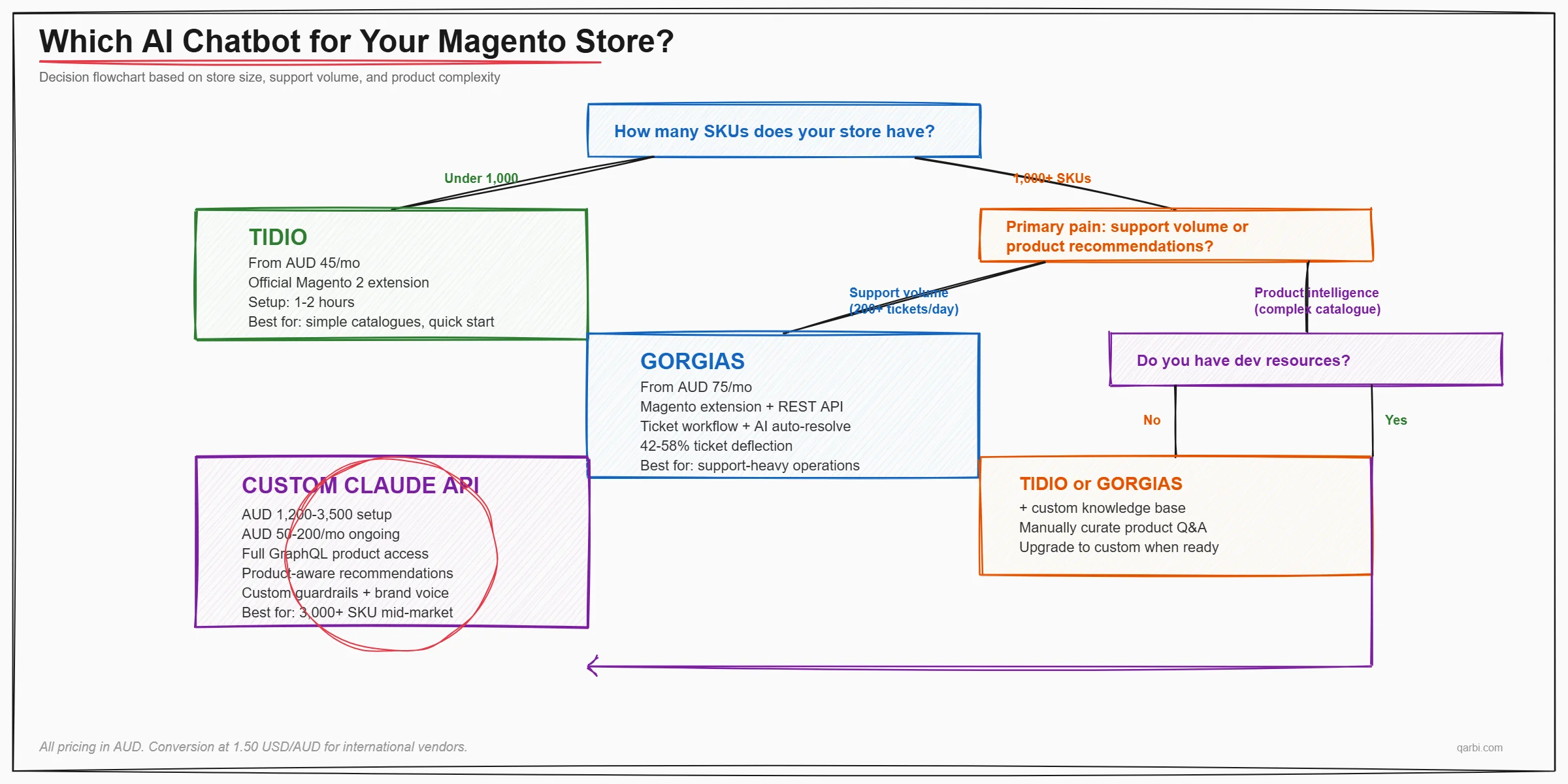
For stores that outgrow Tidio, the usual upgrade path is to Gorgias (for support volume) or a custom Claude API chatbot (for product intelligence). The Tidio data exports cleanly, so migration is not painful.
Gorgias: Best for Customer Support Volume
Gorgias is a helpdesk-first platform that added AI chat capabilities. Its strength is the ticket workflow: every chat conversation becomes a support ticket with full context, SLA tracking, macros, and reporting. For stores doing 200+ support interactions per day, this operational layer matters more than the chatbot's raw intelligence.
Magento integration depth
- Official Magento 2 extension that syncs customer data, order history, and product catalogue.
- Agent sidebar shows the customer's full order history, lifetime value, and recent browsing in Magento while chatting.
- One-click actions from the chat window: refund, cancel order, create return label, apply discount code. These execute directly in Magento via the REST API.
- AI-powered auto-responses trained on your historical ticket data. Accuracy improves as ticket volume grows.
AUD pricing tiers (2026)
| Plan | AUD/mo | Tickets included | AI features |
|---|---|---|---|
| Starter | AUD 75 | 300 tickets | Basic auto-replies |
| Basic | AUD 150 | 1,000 tickets | AI classification + suggested replies |
| Pro | AUD 375 | 5,000 tickets | Full AI auto-resolve + sentiment analysis |
| Enterprise | AUD 525+ | Unlimited | Custom AI training + dedicated CSM |
The ticket deflection rate is the key ROI metric here. On stores where we have deployed Gorgias with its AI enabled, the deflection rate sits between 42% and 58% of tier-1 queries. At an average cost of AUD 8-15 per human-handled ticket (based on AU support staff costs), a store doing 3,000 tickets per month saves AUD 10,000-26,000 per month in support labour. The Pro plan at AUD 375/mo pays for itself many times over.
Custom Claude API Chatbot: Best for Mid-Market Stores
For stores with 3,000+ SKUs, complex product relationships, or specific business logic (trade pricing tiers, minimum order quantities, custom product configuration), no off-the-shelf chatbot will cover your needs. This is where a custom build using the Claude API and Magento's GraphQL API becomes the right answer.
We have built this for two Australian Magento stores and the architecture is the same both times:
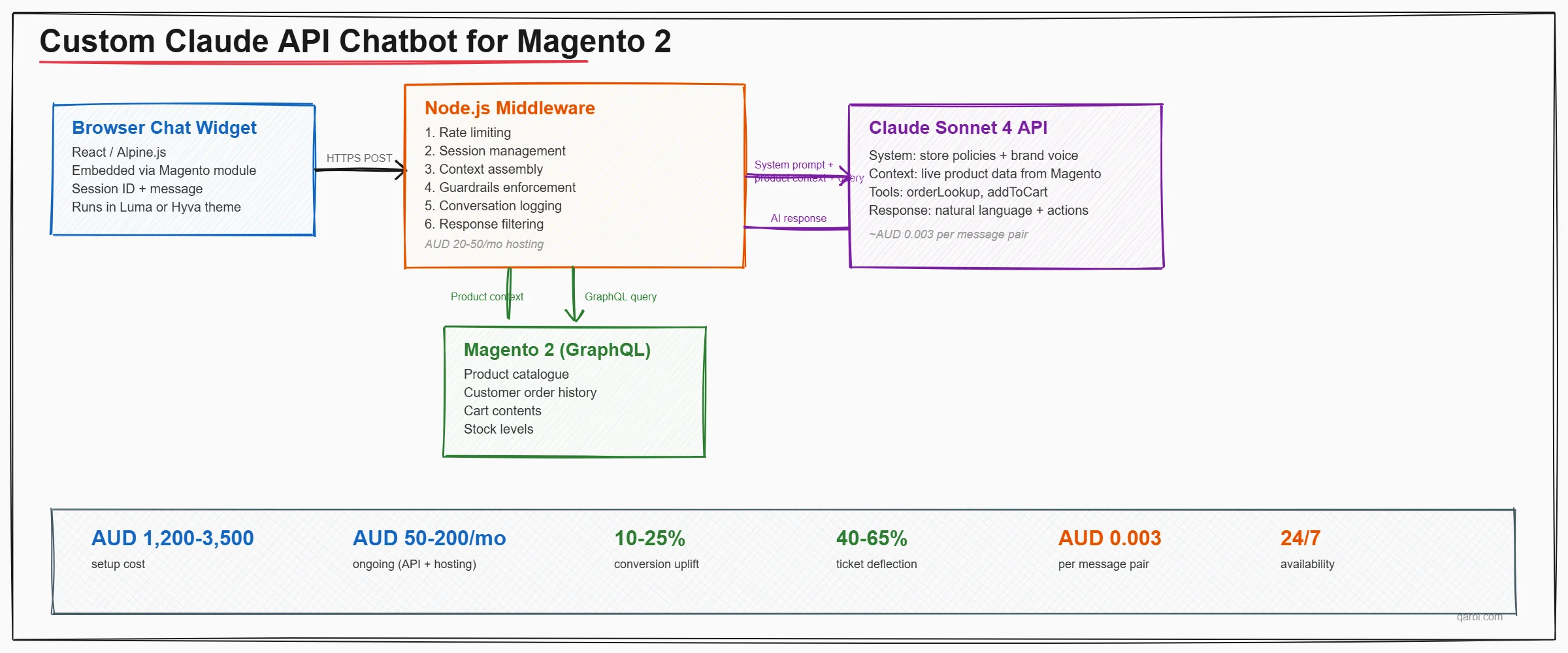
- Frontend widget: A lightweight chat UI embedded in the Magento storefront via a Magento module. React or Alpine.js, depending on whether the store runs Luma or Hyva.
- Middleware: A Node.js service (or Python FastAPI) that sits between the frontend and Claude. It handles session management, rate limiting, and most importantly, context assembly.
- Context assembly: Before every Claude API call, the middleware queries Magento's GraphQL API for relevant product data (based on the customer's current page, search history, and cart contents). This context is injected into the system prompt so Claude's response is grounded in real catalogue data.
- Claude API: Claude Sonnet 4 for the conversational response. System prompt includes the product context, store policies (returns, shipping, payment methods), and brand voice guidelines. Tool use is enabled for order lookup and cart actions.
- Guardrails: The middleware enforces response length limits, blocks any responses that mention competitor products or make price promises, and logs every conversation for compliance review.
Cost breakdown (AUD)
| Component | Setup cost (AUD) | Monthly cost (AUD) | Notes |
|---|---|---|---|
| Magento module (chat widget) | AUD 500-1,000 | AUD 0 | One-time development |
| Node.js middleware | AUD 500-1,500 | AUD 20-50 hosting | VPS or container |
| Claude API credits | - | AUD 30-150 | Depends on conversation volume; ~AUD 0.003 per message pair at Sonnet pricing |
| Testing and QA | AUD 200-500 | - | Conversation testing, edge case handling |
| Total | AUD 1,200-3,500 | AUD 50-200 |
The ongoing cost scales with conversation volume. A store handling 200 chatbot conversations per day at an average of 4 message pairs each costs approximately AUD 75/mo in Claude API credits. That is comparable to a Gorgias Starter plan but with full product intelligence.
          // Simplified: Claude API call with Magento product context
const response = await anthropic.messages.create({
  model: "claude-sonnet-4-20250514",
  max_tokens: 500,
  system: `You are a helpful shopping assistant for ${storeName}.
    Current products on this page: ${JSON.stringify(pageProducts)}
    Customer's cart: ${JSON.stringify(cartItems)}
    Store policies: ${storePolicies}
    Respond in Australian English. Never mention competitor stores.`,
  messages: conversationHistory,
  tools: [orderLookupTool, addToCartTool],
});
AI Chatbot for Product Recommendations
Product recommendation is where AI chatbots deliver the most measurable revenue impact. The data from ecommerce studies consistently shows that chatbot-driven product recommendations convert at 2-4x the rate of static 'related products' widgets, because the recommendation responds to what the customer actually asked for, not what an algorithm guessed.
- Conversational filtering: 'I need a gift for my partner, she likes hiking, budget is AUD 100-150.' A chatbot with catalogue access can filter to relevant products in one exchange. A search box cannot.
- Abandoned cart recovery: When a customer returns to the site with items in cart, the chatbot can proactively offer help: 'I see you have the merino jumper in your cart. Would you like to know about sizing or our free returns policy?' This recovers 8-15% of abandoned carts on stores where we have deployed it.
- Cross-sell at checkout: 'Customers who bought this tent also bought the weatherproof groundsheet. Would you like to add it?' Chatbot-driven cross-sells have a 12-18% acceptance rate vs 3-5% for static widgets.
- Size and fit guidance: 'I am 180cm and 85kg, what size should I get in the slim fit shirt?' This is the query that static product pages handle worst and chatbots handle best.
The caveat is that recommendation quality depends entirely on product data quality. If your Magento catalogue has thin descriptions, missing attributes, and no structured sizing data, the chatbot will not magically know what to recommend. This is where our AI SEO tools guide connects: enriching product data for SEO simultaneously improves chatbot recommendation accuracy.
Implementation: Adding an AI Chatbot to Magento 2
There are three integration approaches for Magento 2, and the right one depends on your frontend architecture.
- Magento extension (Tidio, Gorgias): Install from the Marketplace, configure in the admin panel. Works with both Luma and Hyva themes. Adds a JavaScript snippet to the storefront automatically. Fastest path: under 2 hours.
- JavaScript widget injection (Chatbot.com, most SaaS platforms): Paste a script tag into your theme's default_head_blocks.xml or via Google Tag Manager. No Magento-specific features (no order lookup, no product sync). Setup: 30 minutes to 2 hours.
- Custom API integration (Claude API, OpenAI): Build a Magento module that adds the chat widget and a middleware service that connects to the AI API. Requires development resources. Setup: 1-3 weeks. See the Claude Code guide for how we accelerate Magento module development with AI.
Regardless of which approach you choose, test the chatbot on staging first. Every chatbot we have deployed needed at least one round of prompt tuning to stop it from making incorrect product claims, and another round to match the store's brand voice. Budget 2-3 days for testing before going live.
Measuring Chatbot ROI: The Metrics That Matter
Most chatbot vendors will show you engagement metrics: conversations started, messages sent, satisfaction ratings. These are vanity metrics. The numbers that actually matter for an ecommerce store are the ones that connect to revenue and cost.
| Metric | What it measures | Target range | How to track |
|---|---|---|---|
| Conversion rate uplift | % increase in orders from visitors who interacted with chatbot vs those who did not | 10-25% | GA4 event tracking on chatbot open + ecommerce conversion |
| Ticket deflection rate | % of support queries resolved by AI without human handoff | 40-65% | Chatbot platform analytics (Gorgias, Tidio dashboards) |
| Average order value (AOV) impact | AOV difference for chatbot-assisted orders vs organic | +5-15% | Segment chatbot-assisted orders in Magento reporting |
| Cart abandonment recovery rate | % of abandoned carts recovered via chatbot re-engagement | 8-15% | Magento abandoned cart report + chatbot attribution |
| Cost per resolution | AUD cost to resolve a support query via chatbot vs human agent | AUD 0.50-2.00 vs AUD 8-15 | API costs / total deflected tickets |
The metric that surprises most store owners is cost per resolution. A human agent resolving a 'where is my order' query costs AUD 8-15 when you factor in salary, training, management overhead, and tooling. The same query resolved by an AI chatbot with order tracking integration costs AUD 0.50-2.00 in API credits. On a store doing 3,000 support tickets per month with a 50% deflection rate, that is a saving of AUD 9,000-19,500 per month.
Australian Compliance: Privacy, Consumer Law, and AI Disclosure
Australian ecommerce stores have specific legal obligations when deploying AI chatbots. These are not optional, and getting them wrong exposes you to ACCC enforcement action and Privacy Act penalties.
- AI disclosure: The ACCC's position is that consumers have a right to know when they are interacting with AI rather than a human. Best practice: display a clear notice ('You are chatting with an AI assistant') at the start of every conversation. This is not yet a strict legal mandate in Australia, but the ACCC has signalled it is coming, and early adopters will be on the right side of the line.
- Mandatory human escalation: Every AI chatbot must offer a path to a human agent. Under Australian Consumer Law, consumers have rights to remedies (refund, repair, replacement) that cannot be denied by an AI. If the chatbot cannot resolve a complaint, it must hand off to a human with full conversation context.
- Privacy Act 1988 compliance: If the chatbot collects or processes personal information (name, email, order details, browsing history), you must comply with the Australian Privacy Principles (APPs). Key requirements: a privacy policy that discloses AI processing, data minimisation (do not send more customer data to the AI API than necessary), and data retention limits.
- Product claims: The AI must not make false or misleading representations about products. Under the ACL, the store is liable for claims made by its AI chatbot just as it would be for claims made by a human sales agent. Implement guardrails that prevent the chatbot from making health claims, country-of-origin claims, or price guarantees that are not in the product data.
- Data residency: If using a US-based AI API (Claude, OpenAI), customer data crosses borders. Under the APPs, you must take reasonable steps to ensure the overseas recipient handles data consistently with Australian standards. Practically: review the AI provider's data processing agreement and ensure it meets APP 8 requirements.
Practical checklist: Before go-live, verify: (1) AI disclosure notice is visible, (2) human escalation button works on every page, (3) privacy policy updated to mention AI processing, (4) product claim guardrails tested with adversarial prompts, (5) data processing agreement with AI API provider is signed.
Related Reading
This post is part of our AI for Magento cluster. For the development workflow behind the custom Claude API chatbot, see our Claude Code for Magento development guide. For automating SEO across your product catalogue (which directly improves chatbot recommendation quality), see AI SEO Tools for Magento.
Need help implementing a chatbot on your Magento store? Talk to our team about the right solution for your catalogue size and support volume.
Frequently Asked Questions
What is the best AI chatbot for a Magento ecommerce store in 2026?
For small stores under 1,000 SKUs, Tidio offers the fastest setup with its official Magento 2 extension, starting at AUD 45/mo. For support-heavy stores, Gorgias provides the deepest ticket workflow integration from AUD 75/mo. For mid-market stores with 3,000+ SKUs needing product-aware recommendations, a custom Claude API chatbot (AUD 500-2,000 setup, AUD 50-200/mo) delivers the best results.
How much does an AI chatbot increase ecommerce conversion rates?
AI chatbots typically increase ecommerce conversion rates by 10-25%, with the highest gains from conversational product recommendations and abandoned cart recovery. The impact scales with average order value, so Magento stores (AUD 180-350 AOV) see larger absolute revenue gains than lower-AOV platforms.
Can I build a custom AI chatbot for Magento using Claude or ChatGPT?
Yes. The architecture requires a frontend chat widget (built as a Magento module), a middleware service (Node.js or Python), and the AI API. The middleware queries Magento's GraphQL API for product and order context before each AI call. Setup takes 1-3 weeks and costs AUD 1,200-3,500 for initial development, with AUD 50-200/mo in ongoing API costs.
What are the Australian legal requirements for AI chatbots on ecommerce stores?
Australian stores must comply with the Privacy Act 1988 (disclose AI processing in your privacy policy, minimise personal data sent to AI APIs), Australian Consumer Law (the store is liable for false product claims made by its chatbot), and the ACCC's emerging guidance on AI disclosure (inform customers they are chatting with AI). Mandatory human escalation must be available for complaint resolution.
How much does it cost to run an AI chatbot on a Magento store per month?
SaaS solutions range from AUD 45/mo (Tidio Communicator) to AUD 525+/mo (Gorgias Enterprise). A custom Claude API chatbot costs AUD 50-200/mo in API credits depending on conversation volume, roughly AUD 0.003 per message pair. The ROI benchmark is ticket deflection: a 50% deflection rate on 3,000 monthly tickets saves AUD 9,000-19,500/mo in support labour.
Key takeaway: If you remember nothing else: start with Tidio if you need something running today, evaluate Gorgias if support ticket volume is your primary pain, and build custom with Claude API if your product catalogue is complex enough that generic chatbots keep giving wrong answers.
Frequently Asked Questions
What is the best AI chatbot for a Magento ecommerce store in 2026?
For small stores under 1,000 SKUs, Tidio offers the fastest setup with its official Magento 2 extension, starting at AUD 45/mo. For support-heavy stores, Gorgias provides the deepest ticket workflow integration from AUD 75/mo. For mid-market stores with 3,000+ SKUs needing product-aware recommendations, a custom Claude API chatbot (AUD 500-2,000 setup, AUD 50-200/mo) delivers the best results.
How much does an AI chatbot increase ecommerce conversion rates?
AI chatbots typically increase ecommerce conversion rates by 10-25%, with the highest gains from conversational product recommendations and abandoned cart recovery. The impact scales with average order value, so Magento stores (AUD 180-350 AOV) see larger absolute revenue gains than lower-AOV platforms.
Can I build a custom AI chatbot for Magento using Claude or ChatGPT?
Yes. The architecture requires a frontend chat widget (built as a Magento module), a middleware service (Node.js or Python), and the AI API. The middleware queries Magento's GraphQL API for product and order context before each AI call. Setup takes 1-3 weeks and costs AUD 1,200-3,500 for initial development, with AUD 50-200/mo in ongoing API costs.
What are the Australian legal requirements for AI chatbots on ecommerce stores?
Australian stores must comply with the Privacy Act 1988 (disclose AI processing in your privacy policy, minimise personal data sent to AI APIs), Australian Consumer Law (the store is liable for false product claims made by its chatbot), and the ACCC's emerging guidance on AI disclosure (inform customers they are chatting with AI). Mandatory human escalation must be available for complaint resolution.
How much does it cost to run an AI chatbot on a Magento store per month?
SaaS solutions range from AUD 45/mo (Tidio Communicator) to AUD 525+/mo (Gorgias Enterprise). A custom Claude API chatbot costs AUD 50-200/mo in API credits depending on conversation volume, roughly AUD 0.003 per message pair. The ROI benchmark is ticket deflection: a 50% deflection rate on 3,000 monthly tickets saves AUD 9,000-19,500/mo in support labour.
Ready to fix your store?
Book a free 30-minute audit. We'll review your setup and tell you exactly what we'd do differently.
Book a Free Audit