Shopify Plus is an excellent platform. We say that openly, even though we specialise in Adobe Commerce (Magento). For DTC brands doing $5M-20M with a straightforward catalogue, Shopify Plus is often the right call.
But there is a ceiling. And if you are reading this, you have probably hit it.
This guide breaks down exactly where Shopify Plus falls short for mid-market retailers, where Adobe Commerce wins, and how to decide which platform is right for your next phase of growth. We have migrated 15+ retailers from Shopify Plus to Adobe Commerce, and the pattern is remarkably consistent.
The Shopify Plus Ceiling
Every platform has limits. For Shopify Plus, those limits start showing when your business model grows beyond simple direct-to-consumer ecommerce. We have migrated 15+ retailers from Shopify Plus to Adobe Commerce, and the breaking points follow the same pattern every time.
Here are the most common limitations that push mid-market retailers to look elsewhere:
SKU and variant constraints. Shopify Plus caps product variants at 100 per product and 3 option types. If you sell configurable products like furniture with multiple dimensions, fabrics, and finishes, you hit this wall fast. Workarounds exist, but they involve apps, custom code, and ongoing maintenance. Magento supports unlimited variants and option combinations natively.
Checkout customisation is a walled garden. Shopify controls the checkout experience. While Checkout Extensibility has improved things since the old checkout.liquid days, you still cannot build fully custom multi-step checkout flows, embed complex B2B quoting logic, or create subscription management interfaces without significant workarounds. Magento gives you complete control over every step of the checkout process.
App dependency creates compounding costs and risk. The average Shopify Plus store runs 15-25 apps, each costing $50-$500 per month. That is $750-$12,500 per month in app fees alone, on top of the $2,300+ platform fee. Each app adds page weight, introduces potential conflicts, creates a point of failure, and adds another vendor relationship to manage. When an app developer discontinues their product or changes their pricing, you scramble. On Magento, most of this functionality is built into the core platform.
B2B capabilities are bolted on, not native. Shopify Plus added B2B features in 2023, but they remain limited compared to what mid-market B2B operations actually need. Customer-specific pricing requires a third-party app ($200-$500/mo). Purchase order workflows, approval chains, and company account hierarchies are either missing or shallow. Magento was built for B2B complexity from the ground up.
Multi-store costs compound quickly. Need a separate storefront for wholesale, a different brand, or a regional site? Each additional Shopify Plus store is $2,300+ per month. For a retailer running 3 storefronts, that is $6,900+ per month in platform fees alone. On Adobe Commerce, a single instance serves unlimited storefronts with shared catalogue management, unified reporting, and centralised administration.
Liquid templating has a low ceiling. Shopify themes use Liquid, a templating language that works well for simple stores but becomes painful for complex business logic. You cannot write custom backend logic, create sophisticated pricing rules, or build deep integration layers within the theme. Magento runs on PHP with a full MVC architecture, giving developers access to the entire application stack.
API rate limits throttle growth. Shopify Plus API calls are rate-limited, which becomes a problem when you need real-time inventory sync across multiple warehouses, high-frequency order processing, or complex integration workflows. Large catalogue updates that take minutes on Magento can take hours on Shopify Plus due to API throttling.
The table below summarises the key limitations and how each platform handles them:
When Adobe Commerce Wins
Adobe Commerce is not better than Shopify Plus in every scenario. But for mid-market retailers with complexity in their business model, it is purpose-built for the job. Here are the three areas where the difference is most dramatic.
Pricing Complexity
If your pricing model involves any combination of the following, Adobe Commerce handles it natively while Shopify Plus requires a patchwork of apps:
- Tier pricing - Buy 1-10 at $50, 11-50 at $45, 51+ at $40. Magento supports this out of the box with unlimited tiers per product.
- Customer group pricing - Different prices for retail, wholesale, VIP, and trade customers. Magento lets you create unlimited customer groups, each with their own price book. On Shopify Plus, you need Bold Custom Pricing or a similar app at $200-$500 per month.
- Negotiated quotes - B2B buyers expect to request quotes, negotiate pricing, and have approved prices locked to their account. Magento has a full quote management system built in. Shopify Plus has no equivalent.
- Catalogue price rules - Apply percentage discounts to entire categories, brands, or attribute sets. Stack rules with conditions like customer group + purchase quantity + date range. Magento supports complex rule stacking natively.
- Promotional overrides - Cart price rules that layer on top of catalogue rules, with coupon codes, free shipping thresholds, buy-X-get-Y logic, and bundle pricing. All native in Magento, all requiring apps in Shopify.
For a mid-market retailer with both B2C and B2B channels, these pricing capabilities are not nice-to-haves. They are operational requirements. Building this on Shopify Plus means managing 3-5 pricing apps that may conflict with each other, each adding latency and potential checkout failures.
ERP Integration Depth
Mid-market retailers run on their ERP. Whether it is SAP Business One, NetSuite, MYOB, Pronto, or Xero, the ecommerce platform needs to be a seamless extension of the ERP, not a separate island that syncs overnight.
Adobe Commerce was architected for deep, real-time integrations with enterprise systems. The platform exposes a comprehensive REST and GraphQL API that supports bi-directional sync for orders, inventory, customers, pricing, and product data. You can push and pull data in real time, not just on a scheduled batch.
Shopify Plus integration is typically one-way or middleware-dependent. Most Shopify-to-ERP integrations use tools like Celigo, Boomi, or custom Zapier workflows that sync data on a delay. Real-time bi-directional sync is technically possible but requires significant custom development and ongoing maintenance.
For Australian retailers specifically, this matters more than most people realise. MYOB and Xero are the dominant accounting platforms in Australia, and Magento has mature, well-maintained integrations for both. The MYOB Advanced integration supports real-time inventory sync, automated order processing, customer account mapping, and multi-location warehouse management. On Shopify Plus, MYOB integration options are limited and often require manual data reconciliation.
Full Ownership
This is the philosophical divide between the two platforms, and it has real financial consequences.
On Shopify Plus, you rent. Shopify controls the hosting infrastructure, the checkout experience, the feature roadmap, and the terms of service. They can change pricing, deprecate features, or modify policies at any time. You are a tenant, not an owner.
On Adobe Commerce (Open Source), you own the codebase, the database, the server infrastructure, and every customisation. You can switch hosting providers. You can fork the code. You can hire any developer in the world to work on it. There is no vendor lock-in, no revenue share, and no platform fee.
The financial difference is significant. Shopify Plus charges a minimum of $2,300 per month per store. Above $800,000 per month in transactions, they take a 0.25% revenue share. For a retailer doing $10M per year, that is roughly $27,600 in platform fees plus $6,250 in revenue share, totalling $33,850 per year before you add a single app. Over 5 years, that is $169,250 in platform costs alone.
With Magento Open Source, your platform cost is $0. You pay for hosting ($200-$500/mo for quality managed hosting), development, and maintenance. The total is often lower, and you own every dollar of investment as an asset rather than an expense.
Feature-by-Feature Comparison: Magento vs Shopify Plus
The following table provides a comprehensive feature-by-feature comparison for mid-market retailers evaluating both platforms. We have scored each feature honestly, acknowledging where Shopify Plus wins.
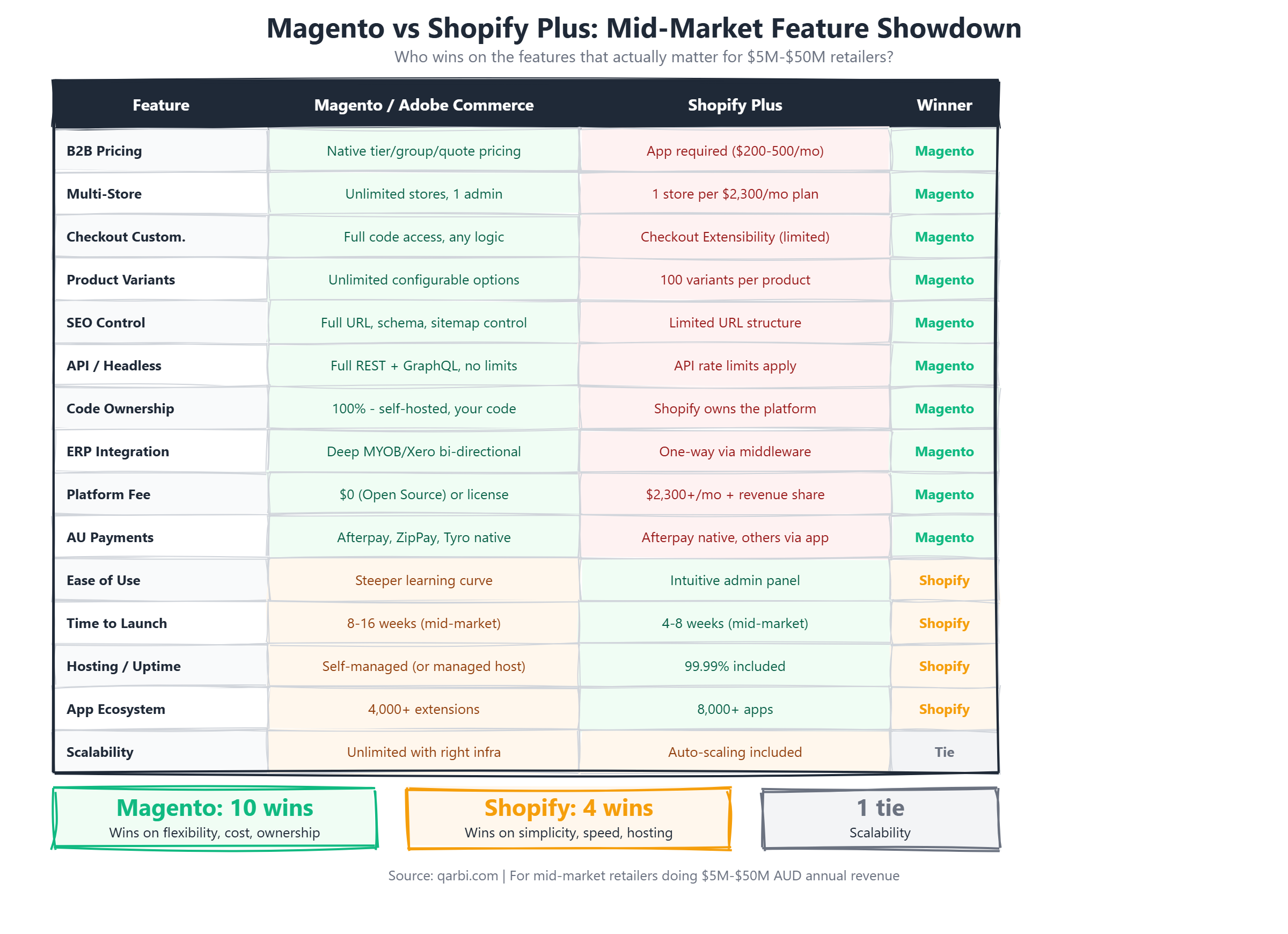
The scorecard shows Magento winning on capability depth while Shopify Plus wins on ease of use and speed to market. For mid-market retailers with complex requirements, capability depth matters more than convenience.
The Cost Question
Cost is the most misunderstood factor in the Magento vs Shopify Plus debate. Shopify Plus looks cheaper on the surface because of its simple monthly fee. But for mid-market retailers, the total cost of ownership over 3 years tells a very different story.
Let us break down a realistic 3-year TCO for a mid-market retailer doing $10M AUD per year in revenue, running a single primary storefront with a wholesale channel.
Key insight: Magento has higher upfront costs but dramatically lower ongoing costs. The crossover point is typically 12-18 months. After that, every month you stay on Shopify Plus costs you more than Magento would.
The app tax is the hidden killer. Mid-market Shopify Plus stores routinely spend $2,000-$5,000 per month on apps for functionality that Magento includes natively. Over 3 years, that is $72,000-$180,000 in app fees alone.
For a detailed breakdown of Magento development costs specific to the Australian market, see our complete guide: Magento Development Cost in Australia 2026.
The bigger cost factor for Magento is development. Traditional Magento agencies in Australia charge $150-$250 per hour. At Qarbi, we deliver the same senior engineering quality at 60% less because we have cut the overhead, not the talent. Our Vietnam-based team works in a similar timezone to AEST and brings deep Magento expertise to every project.
Why This Matters More for Australian Retailers
The Magento vs Shopify Plus debate has an Australian-specific dimension that most comparison articles miss entirely. Here is why the platform choice matters more if you are selling primarily to Australian customers.
AU-specific integrations run deeper on Magento. MYOB, Xero, Afterpay, ZipPay, Australia Post, Tyro, and eWay all have mature, well-maintained Magento extensions. These are not basic API wrappers. The MYOB Advanced module supports bi-directional real-time sync for inventory, orders, customers, and pricing. The Australia Post shipping module calculates real-time rates across all service levels including Express Post, Parcel Post, and StarTrack. On Shopify Plus, these integrations exist but are typically less feature-rich and less actively maintained for the AU market.
GST compliance is more flexible on Magento. Australian GST rules are straightforward for domestic sales, but complexity increases with international orders, GST-free categories (basic food, medical supplies), and B2B transactions where ABN holders may be GST-exempt. Magento tax rules engine handles all of these scenarios natively. Shopify Plus handles basic GST well but requires workarounds for edge cases.
Multi-currency AUD/NZD needs are better served. Many Australian retailers also sell to New Zealand. Magento supports true multi-currency with per-currency pricing, meaning you can set specific NZD prices rather than relying on automatic conversion rates. Shopify Markets supports multi-currency but with conversion-based pricing by default, which can create odd price points that erode customer trust.
Server location affects page speed for AU users. Shopify Plus hosts all stores on servers in the US and Canada. While their CDN helps with static assets, dynamic page generation still happens overseas, adding 150-250ms of latency for Australian visitors. Magento can be hosted on AWS ap-southeast-2 (Sydney) or local Australian hosting providers, delivering sub-50ms TTFB for domestic visitors. For a mid-market retailer where 80%+ of traffic is Australian, this latency difference directly impacts conversion rates. Google research shows that every 100ms of added latency reduces conversion by up to 1.11%.
What Does Migrating from Shopify Plus to Magento Look Like?
If you have decided that Magento is the right platform, the next question is: what does the migration actually involve? Here is a realistic overview of the process for a mid-market retailer.
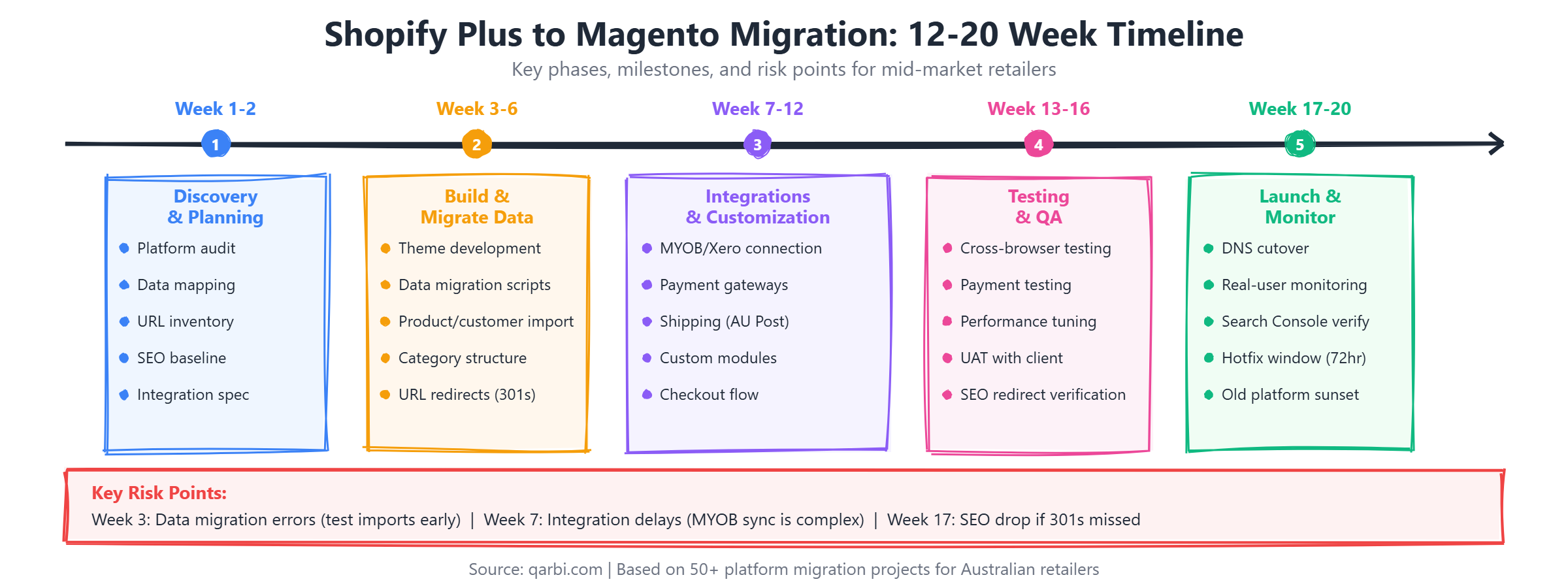
Timeline: A typical mid-market migration from Shopify Plus to Magento takes 12-20 weeks. The range depends on catalogue complexity, number of integrations, and customisation requirements.
The migration follows five key phases:
- Phase 1: Discovery and planning (2-3 weeks) - Audit the existing Shopify Plus store, map all data structures, document integrations, define requirements, and create a detailed migration plan. This phase prevents 90% of migration problems.
- Phase 2: Data migration (2-4 weeks) - Extract products, customers, orders, and content from Shopify Plus. Transform data to match Magento structure. Handle attribute mapping, category restructuring, and customer group assignment. Run test imports and validate data integrity.
- Phase 3: Design and development (4-8 weeks) - Build the Magento storefront, implement the design (often using Hyva theme for performance), configure integrations with ERP, payment gateways, and shipping providers. This is the longest phase and runs in parallel with data migration testing.
- Phase 4: SEO preservation and testing (2-3 weeks) - Map every Shopify URL to its Magento equivalent. Implement 301 redirects for all pages. Verify meta data migration. Run full regression testing across devices and browsers. Test all integrations end-to-end.
- Phase 5: Cutover and launch (1-2 weeks) - Final data sync, DNS switchover, post-launch monitoring, and performance optimisation. We typically run both platforms in parallel for 24-48 hours to ensure zero downtime.
SEO preservation is the number one risk in any platform migration. Improper URL mapping and missing 301 redirects can destroy years of search engine authority overnight. Every URL, every canonical tag, every piece of structured data must be accounted for. This is why we build a comprehensive URL mapping spreadsheet before writing a single line of code.
For retailers considering migration, we offer a free platform audit that evaluates your current Shopify Plus setup and identifies the specific areas where Magento would deliver the most value. Learn more about our migration service.
Is Migration Right for You?
Not every retailer should migrate from Shopify Plus to Magento. We believe in honest advice, even when it means recommending a client stay on their current platform. Here is a decision framework based on what we have seen work.
Migrate TO Adobe Commerce (Magento) if:
- You need B2B functionality (customer-specific pricing, quote management, approval workflows) alongside B2C
- You are running 2+ storefronts and paying $4,600+/mo in Shopify Plus fees
- Your app stack exceeds 15 apps and costs more than $2,000/mo
- You need deep ERP integration with MYOB, SAP, NetSuite, or Pronto that goes beyond basic order sync
- You want to own your codebase and infrastructure with no vendor lock-in or revenue share
Stay on Shopify Plus if:
- You are a pure DTC brand with a simple catalogue and no B2B requirements
- Speed to market is your top priority and you need to launch or iterate in weeks, not months
- You do not have the budget or appetite for custom development and prefer a managed, app-based approach
The honest truth is that Shopify Plus is excellent at what it does. It is the best platform for DTC brands that value simplicity and speed over customisation depth. The problems arise when a retailer outgrows that model, and that is exactly when Magento becomes the better investment.
If you are unsure which category you fall into, we offer a free, no-obligation platform audit. We will review your current setup, identify pain points, and give you an honest recommendation, even if that recommendation is to stay on Shopify Plus. Request a free migration audit.
For retailers who are ready to explore what Adobe Commerce development looks like, our Magento development services page covers our approach, process, and pricing in detail.
Frequently Asked Questions
Is Magento harder to use than Shopify Plus?
The Magento admin panel has a steeper learning curve than Shopify. It offers more configuration options, which means more screens and settings to learn. However, that complexity reflects the platform's power. Most store administrators become comfortable with the Magento admin within 2-3 weeks, and the payoff is access to capabilities that simply do not exist on Shopify Plus. Many retailers find that once they learn Magento, they can manage more of their operations without relying on third-party apps or developer support.
How much does migrating from Shopify Plus to Magento cost?
For a mid-market retailer, a Shopify Plus to Magento migration typically costs $60,000-$150,000 AUD depending on catalogue complexity, number of integrations, customisation requirements, and design scope. This includes data migration, storefront development, integration setup, SEO preservation, testing, and launch support. While this is a significant investment, most retailers recoup the cost within 12-18 months through eliminated platform fees, reduced app costs, and improved operational efficiency.
Will I lose SEO rankings during migration?
Not if the migration is done properly. The key is comprehensive URL mapping and 301 redirect implementation before launch. Every product page, category page, CMS page, and blog post URL must be mapped from the Shopify structure to the Magento structure. Meta titles, descriptions, canonical tags, and structured data must all be preserved. We build a complete URL mapping spreadsheet as part of every migration project and verify redirect coverage before going live. When done correctly, most retailers see stable or improved rankings within 4-6 weeks of migration.
Is Magento still relevant in 2026?
Yes. Adobe Commerce and Magento Open Source power approximately 8% of the top 1 million ecommerce sites globally. The platform received significant updates in 2025 and 2026, including improved GraphQL performance, enhanced B2B features, and better admin UX. The Hyva theme ecosystem has reinvigorated front-end development, delivering Lighthouse scores above 90 on complex stores. The Magento developer community remains one of the largest in ecommerce, ensuring ongoing innovation, security patches, and extension development.
Can I use Magento with Afterpay and MYOB?
Yes. Both Afterpay and MYOB have native Magento integrations that are actively maintained. The Afterpay extension supports standard checkout integration, express checkout, and refund handling. The MYOB Advanced integration supports bi-directional sync for orders, inventory, customers, and pricing. Other popular Australian integrations including Xero, ZipPay, Australia Post, Tyro, and eWay also have mature Magento extensions. Most AU-specific payment and shipping integrations work out of the box with minimal configuration.
Ready to fix your store?
Book a free 30-minute audit. We'll review your setup and tell you exactly what we'd do differently.
Book a Free Audit