Magento development cost in Australia ranges from $10,000-$60,000 AUD for Magento Open Source builds to $50,000-$200,000+ AUD for Adobe Commerce enterprise projects - but these numbers mean nothing without understanding what drives them. The license, the hosting, the development hours, the extensions you didn't budget for, and the ongoing maintenance that nobody mentioned in the sales pitch.
This guide breaks down every cost component in AUD, based on real project data from 50+ Magento builds across Australia and 8 countries. No vague ranges. No "contact us for a quote" dodges. Just transparent numbers so you can budget accurately - whether you're building from scratch, migrating from Shopify Plus or WooCommerce, or upgrading a legacy Magento 1 store.
Magento License Costs: Open Source vs Adobe Commerce vs Cloud
Magento comes in three flavours, each with dramatically different cost profiles. Understanding which one fits your business is the first - and most expensive - decision you'll make.
Magento Open Source is the community edition - free to download, free to use. There's no license fee. The cost comes entirely from hosting, development, extensions, and maintenance. For Australian retailers under $5M in annual revenue who don't need B2B features or multi-store architecture, this is typically the right starting point.
Adobe Commerce (formerly Magento Commerce) adds native B2B capabilities, content staging, customer segmentation, and cloud tools. The license fee scales with your gross merchandise value (GMV) - starting at $22,000 USD (~$34,000 AUD) per year for businesses under $1M GMV, climbing to $75,000+ USD (~$115,000+ AUD) for businesses doing $10M-$25M.
Adobe Commerce Cloud is the fully managed SaaS version that reached general availability in June 2025. It includes AWS hosting, CDN, auto-scaling, and CI/CD pipelines. License fees start higher - around $40,000 USD (~$62,000 AUD) per year - but you eliminate the complexity and cost of managing your own infrastructure.
AUD pricing note: Adobe quotes license fees in USD. At the current exchange rate (~1.54 AUD/USD), a $22,000 USD license costs approximately $34,000 AUD. Budget in AUD and add a 5-10% buffer for exchange rate fluctuations.
Development Costs by Project Type
Development is the largest single cost in any Magento project. The range is wide because complexity varies enormously - a simple B2C store with 500 products is a fundamentally different build from a B2B portal with customer-specific pricing, ERP integration, and multi-warehouse fulfilment.
Understanding what drives costs in each tier helps you budget accurately and avoid surprises. A simple B2C store ($10,000-$30,000 AUD) uses an out-of-the-box Magento installation with theme customisation, basic payment gateway setup (Stripe, Afterpay), standard flat-rate or table-rate shipping, and minimal catalogue configuration. These builds typically take 4-8 weeks and suit retailers launching their first online store with under 5,000 SKUs and no complex integration requirements.
A custom B2C or mid-market store ($30,000-$80,000 AUD) involves custom integrations with accounting software (MYOB, Xero), warehouse management systems, multi-store configurations for different brands or regions, custom checkout flows, and product configurators. Development timelines stretch to 8-16 weeks because each integration requires API mapping, testing across environments, and error handling for edge cases. Most mid-market Australian retailers doing $2M-$20M in annual revenue fall into this bracket.
At the enterprise level ($80,000-$250,000+ AUD), you are looking at Adobe Commerce Cloud deployments, B2B portals with customer-specific pricing and approval workflows, multi-vendor marketplace functionality, headless frontend architectures (React or Vue storefronts), and complex ERP integrations with systems like NetSuite or SAP. These projects run 16-40 weeks and require dedicated project management, staged rollouts, and extensive load testing before launch.
Budget reality check: Most mid-market retailers in Australia fall into the $30,000-$80,000 range. If you are quoted significantly less, ask what is being left out - integration testing, performance optimisation, security hardening, and post-launch support are the first things cut to hit a lower number.
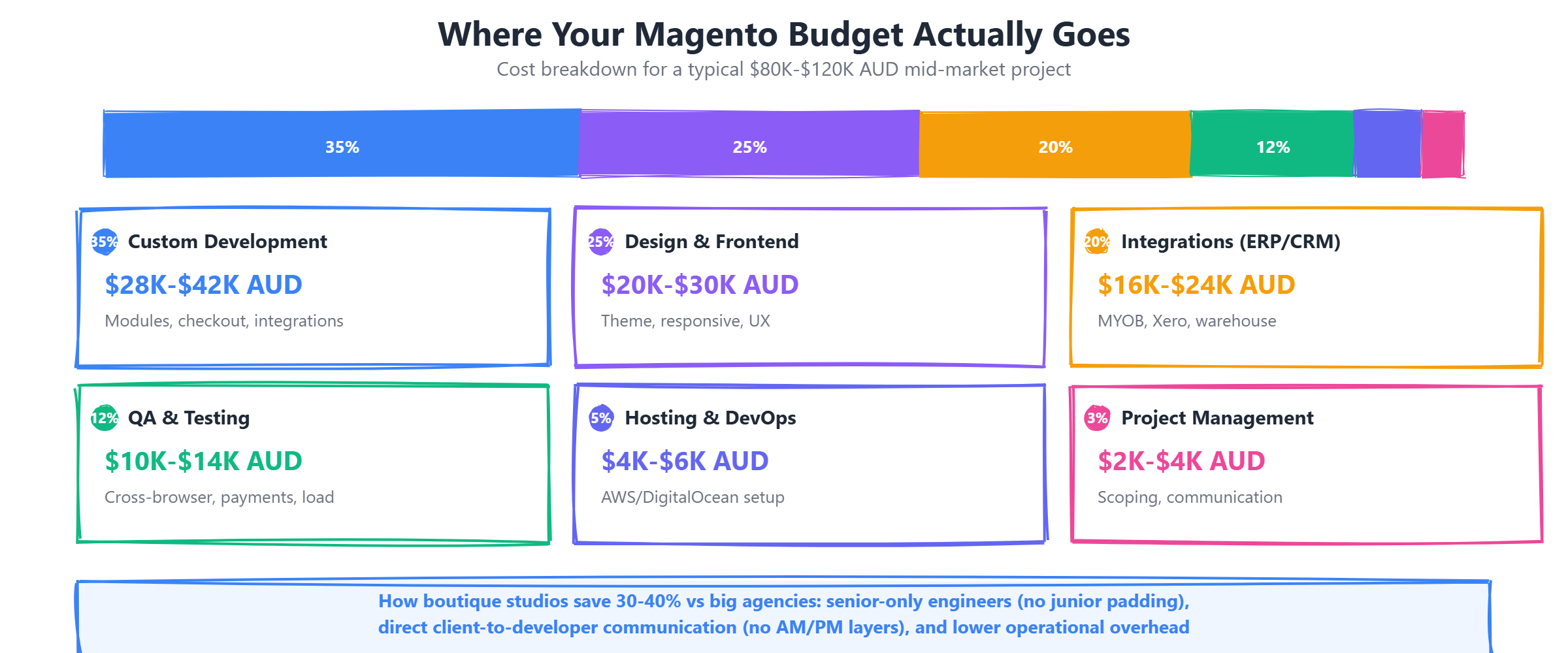
These ranges assume a boutique studio or mid-tier agency. If you're working with a top-tier Australian agency (Balance Internet, Overdose Digital, etc.), add 40-100% to these numbers - not because the work is better, but because the overhead is higher.
Agency vs Boutique Studio vs Freelancer: What You're Actually Paying For
The hourly rate you pay tells you almost nothing about the value you receive. A $200/hr agency and a $70/hr boutique studio can deliver identical work - the difference is in what your money funds.
At a traditional Australian agency, only 30-40% of your billed rate goes to the person writing code. The rest funds project managers, account executives, CBD office leases, and business development - none of which adds value to your Magento store. A boutique studio eliminates these layers, so 80-90% of your spend goes directly to engineering.
That said, freelancers carry their own risks. A solo developer at $40/hr might seem like a bargain until they disappear mid-project, deliver untested code, or can't handle the complexity of your ERP integration. The sweet spot for most mid-market Australian retailers is a boutique studio with senior engineers - agency-quality work without agency overhead.
Why boutique studios offer the best value for mid-market retailers. At a boutique studio, every engineer working on your project is senior-level - typically 5-10+ years of Magento-specific experience. There is no junior padding where a graduate developer handles complex integration work at senior rates. You get direct access to the decision-makers and the people writing your code, which eliminates the telephone game that plagues large agencies. Lower overhead (no CBD office, no sales team, no layers of management) translates directly into savings of 30-40% compared to traditional agencies for equivalent quality work. The result: you pay for engineering, not empire.
The hidden risks of going with a freelancer. Solo freelancers at $30-$50/hr can seem like the smartest financial decision - until reality hits. If your freelancer gets sick, takes another contract, or simply disappears mid-project, you have zero backup. There is no code review process, which means bugs and security vulnerabilities ship to production unchecked. When launch day approaches and you need three developers working in parallel to hit the deadline, a single freelancer cannot scale. And IP ownership can be ambiguous - without proper contracts, the freelancer may retain rights to custom code they wrote for you. Australian retailers who start with a freelancer frequently spend $15,000-$30,000 in rescue work within the first year to fix code quality issues.
When a big agency IS the right choice. Large agencies earn their premium in specific scenarios: when you need 10+ developers working in parallel on a massive platform build, when you require on-site presence for workshops and stakeholder alignment, or when you need Adobe Commerce Cloud managed services with contractual SLAs and 24/7 support. If your project budget exceeds $200,000 AUD and involves complex multi-department coordination, the project management overhead of a large agency becomes a genuine value-add rather than dead weight.
The Hidden Costs of Magento Nobody Talks About
The development quote is just the beginning. Here's what most agencies conveniently leave out of the initial proposal - costs that show up in Month 2 and every month after.
- Hosting: $200-$1,000+ AUD/month. Magento is resource-hungry. Shared hosting won't cut it. Budget for VPS ($200-$400/mo), dedicated ($400-$800/mo), or managed cloud like Nexcess or AWS ($500-$1,500+/mo). Australian-hosted servers cost 20-30% more than US-based ones, but deliver better page speed for AU customers.
- SSL Certificate: $0-$300 AUD/year. Let's Encrypt is free. Extended Validation (EV) certificates for enterprise trust signals cost $150-$300/year.
- Extension Licenses: $5,000-$15,000 AUD/year. Search (Algolia/Elasticsearch: $500-$3,000), reviews (Yotpo: $500-$2,000), email marketing (Klaviyo: varies), payment gateways (Afterpay, Zip), shipping (Shippit, Temando). Each has its own subscription.
- Security Patches: $2,000-$5,000 AUD/year. Adobe now releases security patches monthly (since January 2026). Someone needs to test and apply them. Skip this and you're inviting data breaches, PCI compliance failures, and credit card skimmers.
- Ongoing Maintenance: $1,000-$4,000 AUD/month. Bug fixes, performance monitoring, small feature requests, compatibility updates when PHP or MySQL releases new versions. Budget $12,000-$48,000/year.
- CDN: $50-$300 AUD/month. Cloudflare (free tier works), Fastly, or AWS CloudFront. Essential for Australian stores serving international traffic.
- Staging Environment: $100-$300 AUD/month. You need a copy of your production environment for testing changes before they go live. Most agencies charge for this separately.
Real numbers: A mid-market Magento store with 10,000 products, 3-4 integrations, and reasonable traffic typically spends $3,000-$6,000 AUD/month on hosting, maintenance, extensions, and security - on top of the initial build cost. Budget for this from day one.
Australia-specific hidden costs that catch retailers off guard:
- MYOB/Xero integration: $5,000-$15,000 AUD. Most agencies quote one-way sync (orders pushed to accounting software). Proper bi-directional sync - where inventory levels, customer accounts, and credit notes flow both ways in real time - costs significantly more but prevents the manual reconciliation nightmare that eats 5-10 hours per week.
- Afterpay/Zip Pay setup: $2,000-$5,000 AUD. The basic plugin install is straightforward, but proper implementation includes fallback handling when the payment provider is down, order status synchronisation, refund workflows, and thorough testing across mobile and desktop checkout flows.
- GST compliance configuration: $1,000-$3,000 AUD. Magento tax rules need careful configuration for Australian GST. This includes handling GST-free items (basic food, medical supplies), GST on shipping, tax-inclusive vs tax-exclusive display pricing, and proper tax invoicing that meets ATO requirements.
- Australia Post shipping integration: $3,000-$8,000 AUD. Real-time rate calculation from the Australia Post API, click-and-collect location mapping, express vs standard logic, dimensional weight handling, and proper error fallbacks when the API is slow or unavailable during peak periods like Black Friday.
- Multi-currency for NZ market: $2,000-$5,000 AUD. If you sell to New Zealand, you need NZD currency support with accurate exchange rate updates, separate payment gateway configuration, and potentially different shipping rules and tax treatment.
How to Reduce Magento Development Costs Without Cutting Quality
You don't have to choose between quality and cost. Here are the strategies that mid-market Australian retailers use to get senior-level Magento development at a fraction of the traditional agency price.
- Work with a boutique studio, not a big agency. Cut the overhead, not the talent. A Vietnam-based studio with senior Australian-experienced engineers delivers the same quality at 40-60% less. You talk directly to the engineer who builds it - no PM tax, no account manager markup.
- Start with Magento Open Source. Unless you specifically need Adobe Commerce's B2B module, content staging, or cloud infrastructure, start with Open Source and upgrade later. You'll save $34,000+ AUD/year in license fees.
- Use Hyva theme instead of custom design. A custom Luma design costs $15,000-$40,000. Hyva theme implementation delivers sub-2-second load times at $15,000-$30,000 - faster to build, faster to load, better for SEO.
- Audit before you build. A $500-$1,000 store audit identifies what actually needs building vs what's nice-to-have. Many retailers spend $30,000+ on features they never use because nobody challenged the scope.
- Sprint-based development. Fixed-price sprints (2-4 weeks each) let you launch faster and adjust priorities as you go. You see working code in weeks, not months.
- Don't over-extend with extensions. Each extension adds cost, complexity, and a potential failure point. Before buying a $2,000/year extension, ask your developer if the same functionality can be built natively in 10-20 hours of development time.
Total Cost of Ownership: Year 1 and Ongoing
Here's what a Magento store actually costs over the first two years - the number your agency should give you upfront but rarely does.
The difference between boutique and traditional agency is stark. For an Open Source build, you're looking at $35,600-$96,200 AUD (boutique) vs $74,600-$193,200 AUD (traditional agency) in Year 1 - the same platform, the same features, the same quality of code. The gap is entirely overhead.
Cost optimisation over time. Year 1 is always the most expensive because it includes the full build cost plus initial setup of hosting, integrations, and extensions. Year 2 onwards drops significantly to hosting, maintenance, and incremental feature development - typically 40-60% less than Year 1. This is where the long-term economics of Magento become compelling.
Investing in quality upfront saves 2-3x in maintenance costs down the line. Stores built cheaply by inexperienced freelancers or offshore teams with no Magento expertise often need $20,000-$40,000 in rescue work within the first 18 months - fixing security vulnerabilities, rebuilding poorly architected custom modules, and resolving performance issues that tank conversion rates. The cheapest build is rarely the cheapest outcome.
For perspective, compare Magento TCO to Shopify Plus: Shopify Plus charges $2,300 USD/month in platform fees alone - that is approximately $42,500 AUD per year. Add apps at $500-$2,000/month ($9,000-$36,000 AUD/year) for functionality that Magento includes natively or via one-time extension purchases, and Shopify Plus frequently costs more than a well-built Magento Open Source store after 3 years for mid-market retailers with complex requirements.
What Actually Affects Your Magento Quote
When you ask a Magento agency for a quote, here are the variables that move the number - so you know what to optimise.
- Catalogue size: 500 products vs 50,000 products affects data migration, search infrastructure, and category page performance.
- Custom design vs theme: A fully custom design adds $15,000-$40,000 AUD. A Hyva theme implementation with customisation costs $15,000-$30,000 and performs significantly better.
- Integrations: Each ERP, PIM, CRM, or third-party integration adds $3,000-$15,000 AUD. Common for AU retailers: MYOB, Xero, NetSuite, Shippit, Afterpay, Zip, Klaviyo.
- B2B features: Customer-specific pricing, quoting workflows, company accounts, and approval chains add $20,000-$60,000 AUD.
- Multi-store: Running multiple storefronts (different brands, AU + NZ, wholesale + retail) adds $5,000-$20,000 AUD.
- Migration complexity: Simple migrations start at $15,000; complex ones with custom code translation exceed $100,000.
Magento vs Shopify Plus: Total Cost Comparison for Australian Retailers
The most common question Australian mid-market retailers ask is whether Magento or Shopify Plus is more cost-effective. The answer depends entirely on your timeline. Shopify Plus has lower upfront costs but higher ongoing fees. Magento has higher upfront investment but dramatically lower long-term costs - especially for stores with complex requirements that would need multiple paid Shopify apps.
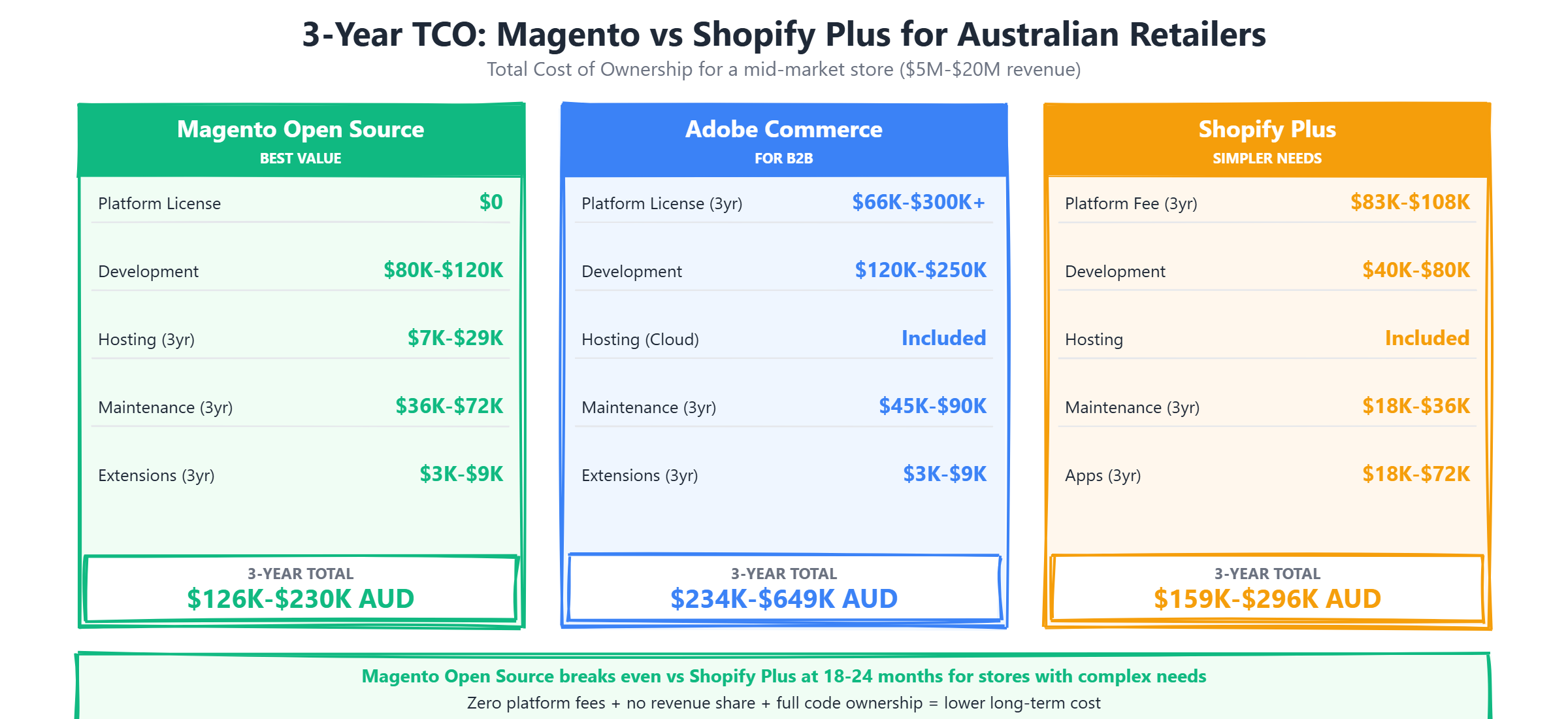
Here is a realistic 3-year total cost of ownership comparison for a mid-market Australian retailer doing $5M-$20M in annual revenue, with 5,000-50,000 SKUs, 3-5 integrations, and custom checkout requirements:
The numbers reveal a critical insight: Magento Open Source is the most cost-effective platform over 3 years for mid-market stores with complex needs. The higher upfront development cost pays for itself through zero platform license fees, no revenue-share percentages, and no dependency on expensive third-party apps for core functionality. The typical break-even point where Magento becomes cheaper than Shopify Plus is 18-24 months. For stores with simpler requirements and fewer integrations, Shopify Plus may remain more cost-effective - but those stores rarely need the flexibility that drives them to evaluate Magento in the first place.
How to Get an Accurate Quote (and Avoid Blowouts)
Most Magento project cost blowouts happen because the scope wasn't defined properly upfront. Here's how to get a quote you can trust.
- Start with an audit, not a build. A $500-$1,000 store audit (or a free audit from Qarbi) identifies exactly what needs building.
- Ask for fixed-price sprints. Agencies love hourly billing because scope creep is their profit centre. Sprint-based pricing puts the risk on the agency, not you.
- Ask who actually builds it. If the senior developer in the sales meeting isn't the person writing your code, you're paying for a bait-and-switch.
- Get the Year 2 number. Ask for total cost of ownership - hosting, maintenance, extensions, and licence fees - for Year 2 and beyond.
- Check references in your industry. Ask for references from retailers with similar catalogue size, integration needs, and revenue range.
The best indicator of an honest agency isn't the lowest quote - it's the one that tells you what you don't need. If an agency recommends Adobe Commerce for a $2M store with no B2B needs, they're upselling you $34,000/year in unnecessary licence fees.
Frequently Asked Questions
Is Magento Open Source really free?
The software license is free. But a production-ready Magento Open Source store requires hosting ($200-$600 AUD/month), SSL certificates, development ($10,000-$60,000 AUD for initial build), extensions ($5,000-$15,000 AUD/year), and ongoing maintenance. The total Year 1 cost is typically $25,000-$75,000 AUD.
How much does an Adobe Commerce license cost in Australia?
Adobe Commerce license fees start at approximately $22,000 USD (~$34,000 AUD) per year for businesses under $1M in gross merchandise value, scaling to $75,000+ USD (~$115,000+ AUD) for businesses between $10M-$25M GMV. These are annual fees - you pay them every year.
Why are Australian Magento agencies so expensive?
Traditional Australian agencies charge $150-$250/hr AUD because you're paying for CBD office space, project managers, account executives, sales teams, and profit margins - on top of the actual engineering. Only 30-40% of your bill goes to development work. Boutique studios eliminate these overhead layers, delivering the same senior engineering at $50-$90/hr AUD.
How much does a Magento migration cost in Australia?
Platform migrations to Adobe Commerce typically cost $15,000-$50,000 AUD for simple stores (under 5,000 SKUs, few integrations) and $50,000-$150,000+ AUD for complex stores with custom modules, B2B features, and ERP integrations. This includes data migration, frontend rebuild, SEO preservation, and post-launch stabilization.
Is offshore Magento development worth it?
It depends on the model. Cheap freelancers at $15-$30/hr often cost more long-term due to quality issues, communication gaps, and rework. Structured offshore studios with senior engineers (5-8+ years experience), English fluency, and timezone overlap deliver genuine savings of 40-60% while maintaining quality. The key differentiator is team seniority, not geography.
How much does a basic Magento store cost in Australia?
A basic Magento Open Source store in Australia costs $10,000-$30,000 AUD for development, plus $200-$600/month for hosting and $5,000-$15,000/year for extensions and maintenance. The total Year 1 cost for a simple B2C store with under 5,000 products is typically $25,000-$60,000 AUD all-in.
Is Magento more expensive than Shopify?
Magento has higher upfront development costs ($30,000-$80,000 vs $20,000-$50,000 for Shopify Plus) but significantly lower long-term costs for complex stores. Shopify Plus charges $2,300 USD/month in platform fees (~$42,500 AUD/year) plus app subscriptions that can add $500-$2,000/month. For mid-market stores with 3+ integrations, Magento Open Source typically becomes cheaper than Shopify Plus after 18-24 months.
How much does Magento hosting cost in Australia?
Managed Magento hosting in Australia costs $200-$800 AUD/month depending on your traffic and catalogue size. VPS hosting starts at $200-$400/month, dedicated servers run $400-$800/month, and managed cloud hosting (AWS, Nexcess) costs $500-$1,500+/month. Australian-hosted servers cost 20-30% more than US-based alternatives but deliver better page load times for local customers.
Should I use Adobe Commerce or Magento Open Source?
Magento Open Source is the right choice for most mid-market Australian retailers doing under $10M in annual revenue without B2B requirements. Adobe Commerce ($34,000+ AUD/year license) makes sense when you specifically need native B2B features (customer-specific pricing, company accounts, approval workflows), content staging for large marketing teams, or Adobe Commerce Cloud managed infrastructure. Do not pay for Adobe Commerce just because an agency recommends it - ask exactly which Commerce-only features you need.
How long does a Magento project take?
A simple Magento B2C store takes 4-8 weeks. A mid-market custom store with integrations takes 8-16 weeks. Enterprise builds with B2B portals, marketplace features, or complex ERP integrations take 16-40 weeks. Platform migrations add 2-4 weeks for data migration and SEO preservation. These timelines assume a dedicated team - if your agency is splitting resources across multiple projects, expect 30-50% longer.
Ready to fix your store?
Book a free 30-minute audit. We'll review your setup and tell you exactly what we'd do differently.
Book a Free Audit